Strengthening Global Citizenship Education in Technical and Vocational Education and Training
Why GCE in (T)VET?
Our world is becoming increasingly globalized and interconnected. This brings opportunities, but also complex challenges for future generations. It is therefore only natural that young people seek the knowledge and skills to understand complex problems, adapt, and find solutions together. Global citizenship education offers an answer to this need, as it provides young people with the tools and knowledge they require in their quest for a fairer and more sustainable world.
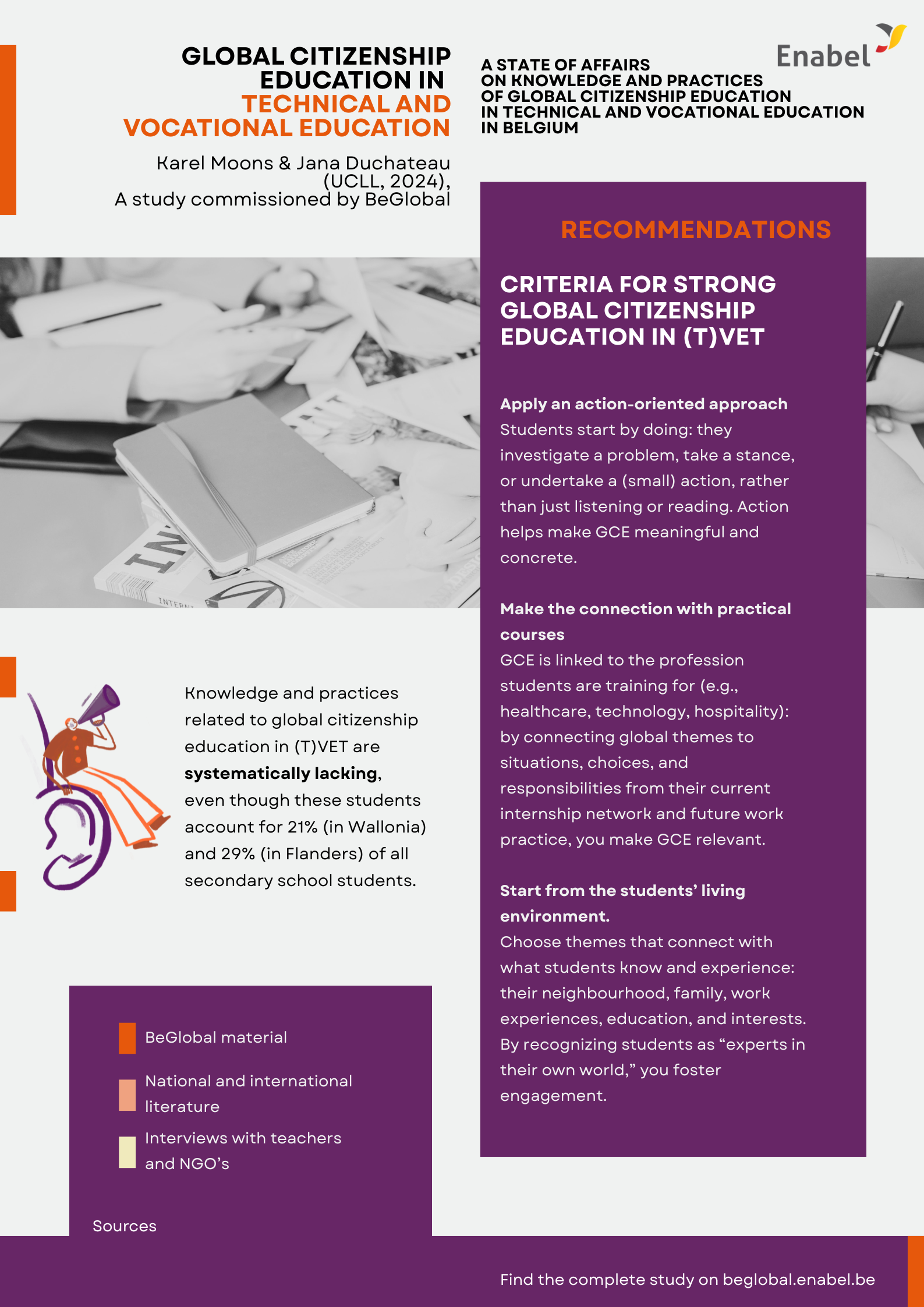
The DGD’s strategic note on global citizenship education in Belgium (available in Dutch and French) emphasizes the urgency and importance of integrating GCE skills into all streams. (T)VET students are explicitly identified as a target group under the motto ‘Leave No One Behind’, as they have less exposure to GCE activities, even though they represent 21% of secondary school students in Wallonia and 29% in Flanders. This is because GCE practices and methods are typically developed for students in general education.
More specifically: how? / Where are we coming from?
The study
Global Citizenship Education in Technical and Vocational Education and Training
Community of Practice
Reflecting together about GCE in the (T)VET
Pilot project in Flanders
Kapt Ermee!
Pilot project in Fédération Wallonie-Bruxelles
Oh purée, on a la patate !
2030
A key finding from the study is that knowledge and practices regarding GCE in (T)VET are systematically lacking. GCE actors, teachers, and schools play an important role, but need knowledge and tools specifically designed for (T)VET settings. With this project, BeGlobal aims to bridge that gap.
The study: a state-of-affairs review of GCE knowledge and practices in (T)VET
The study “Global Citizenship Education in Technical and Vocational Education and Training” was conducted in 2024 on behalf of BeGlobal by a research team from UCLL University College. It provides an overview of national and international literature, complemented by interviews with NGOs and teachers on the current state of and challenges facing global citizenship education in (T)VET in Belgium.
The study confirms what the LNOB principles also emphasize, like the importance of experiential learning, and that it is essential to view and treat students as fully capable and empowered participants in a co-creation process and not merely as a target group. The study confirms that when students are given the opportunity to decide, create, test, and use their voice, their engagement and motivation increase. In this way, global citizenship education, provided with the right approach is taken, can become a space for dialogue and a lever for empowerment.
Two pilot projects
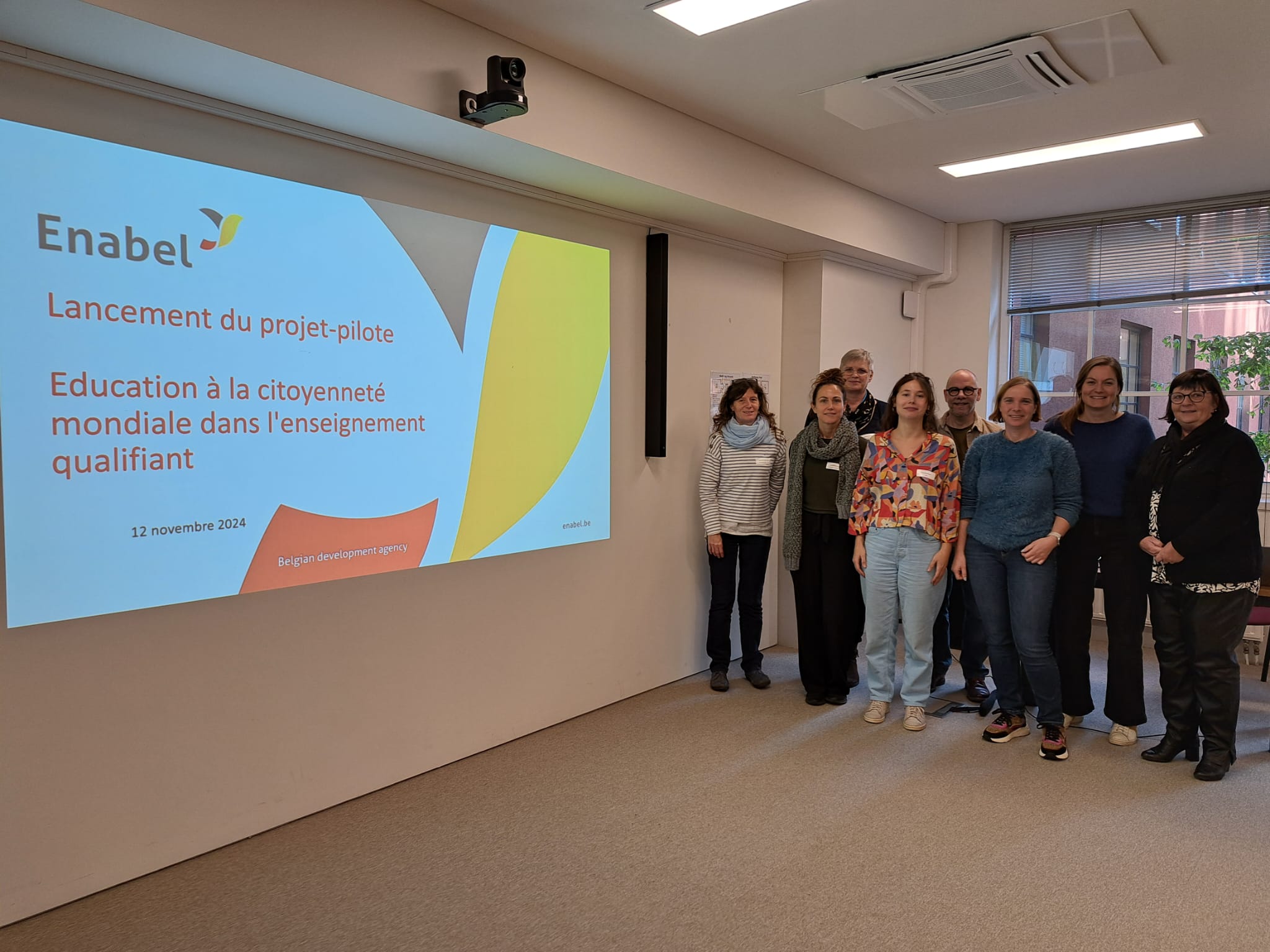
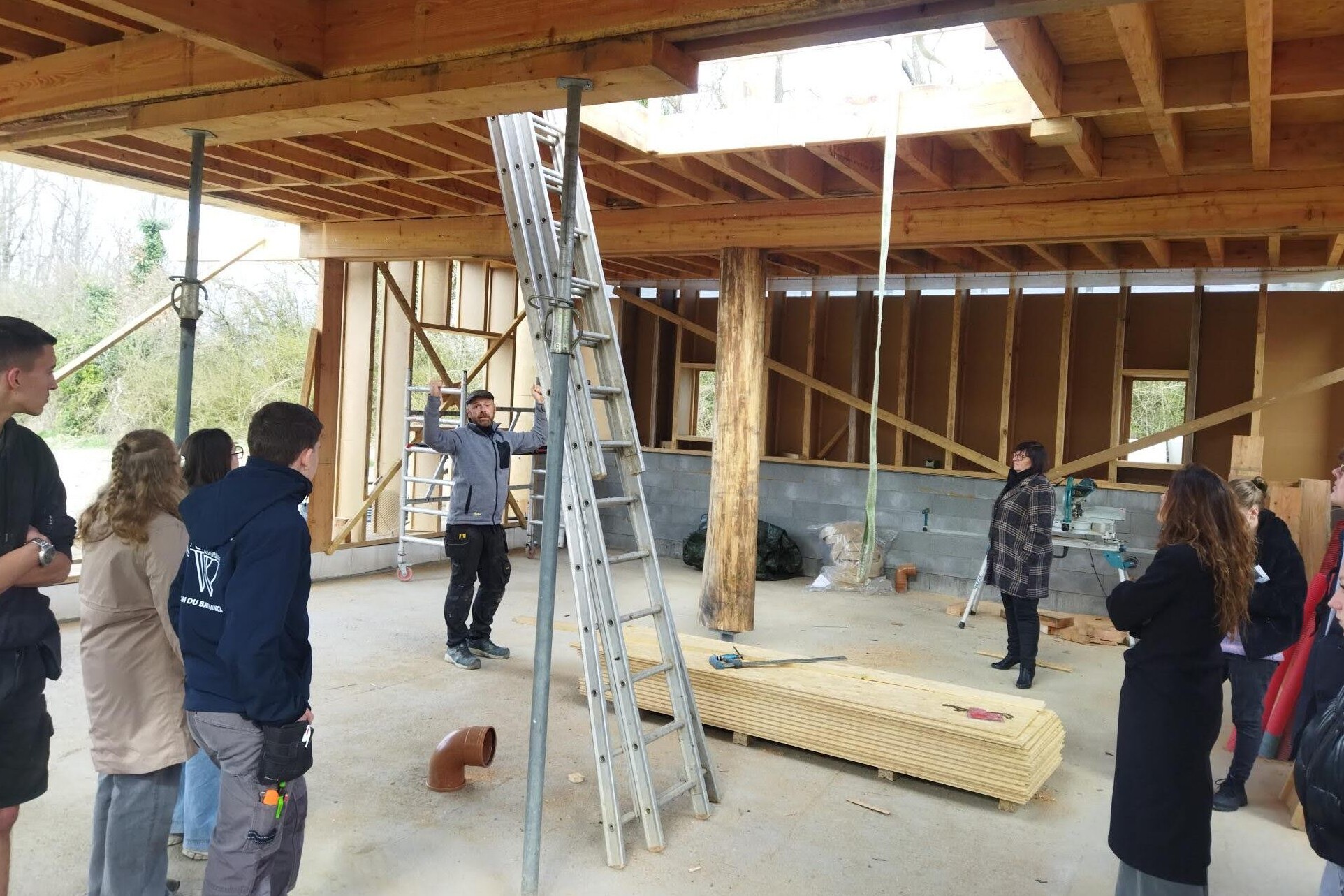
During the 2024–2025 school year, a GCE pilot project in (T)VET schools was launched on both sides of the language border. In Flanders, the KTA Centre for Dual Learning in Bruges collaborated with a NGO consortium Djapo and Studio Globo. In Wallonia-Brussels, the Athénée Royal Rochefort-Jemelle was supported by Entraide & Fraternité. The goal was to test the study’s recommendations against the reality of the school environment.
The pilot projects indeed confirmed the importance of:
- Action-oriented learning. Students start by doing: they investigate a problem, take a stance, or undertake a however small concrete, action, rather than simply listening or reading. Acting helps make GCE meaningful and tangible.
- Making the connection with practical courses. GCE is linked to the profession students are training for (e.g., healthcare, technology, hospitality): by drawing connections between global issues and the situations, choices, and responsibilities from their current internship network and future work practice, GCE becomes genuinely relevant.
- Starting from the students “lived experience”. Choose themes that resonate with what students know and experience in their daily lives: their neighbourhood, family, work experiences, education, and interests. By recognizing students as “experts in their own world,” you foster both engagement and sense of ownership.
What’s next? Community of Practice
Building on the findings from the study and the pilot projects, we aim to launch an action research and action pathway in the form of a Community of Practice (CoP). This will be a space for regular encounters where organisations, teachers, and experts learn together to strengthen global citizenship practices in (T)VET, spotlight inspiring approaches and methods, and build a shared body of knowledge:
- Embedding GCE in technical and vocational education;
- Disseminating the knowledge and practices gathered to all stakeholders in the GCE and (T)VET sectors.
Be part of this collective journey of reflection and discovery. Reach out to us at: beglobal@enabel.be.