Mapping: youth engagement and international solidarity
An overview of organisations working with youth on international solidarity
Today’s youth want to make a difference in promoting greater justice, solidarity, and a sustainable future. BeGlobal therefore wants to map out the activities and experiences of organizations working with youth aged 16 to 35 on international solidarity.
Why mapping youth engagement and international solidarity?
Young people in Belgium are growing up in a rapidly changing world with major social challenges such as polarisation, climate change, increasing social inequality, geopolitical tensions and digital transformation. At the same time, they show a great willingness to get involved and make a difference.
This engagement often arises outside the school walls within what is known as non-formal learning. Think of youth organisations, socio-cultural associations, sports and cultural initiatives, NGOs and local youth initiatives and networks. These actors play a crucial role: they reach young people in an accessible way and are closely connected to their world.
However, there is currently no up-to-date and comprehensive overview of who reaches young people, how this is done and how organisations work on global issues and international solidarity.
BeGlobal wants to change this. This mapping helps to bring together insights from the field and contributes to a better coordinated policy on youth engagement, global citizenship education and international solidarity in Belgium.
What do we want to identify with this mapping?
The mapping is about having an overview of organisations, collectives and initiatives that work within non-formal learning with young people on international solidarity.
With this mapping, we identify:
- who these actors are,
- how they work (explicitly or implicitly) on international solidarity and global citizenship,
- how they raise awareness and mobilise young people around global issues,
- which young people are reached (and which are not),
- what forms of engagement and methodologies are used,
- and what trends, needs and opportunities organisations experience in their work.
Who is included in the mapping?
Everyone who works within non-formal learning with young people aged 16 to 35 on global citizenship and/or international solidarity, in all regions of Belgium, such as:
- Youth organisations
- NGOs and civil society organisations
- Diaspora organisations
- Socio-cultural organisations
- Sports and cultural organisations
- Media
- Private organisations or foundations
- Local, regional and international authorities
How are we going to do this?
Through an online survey or an online (in-depth) interview.
The results and findings will subsequently be available on our website.
Any questions?
Feel free to contact us at mapping@enabel.be
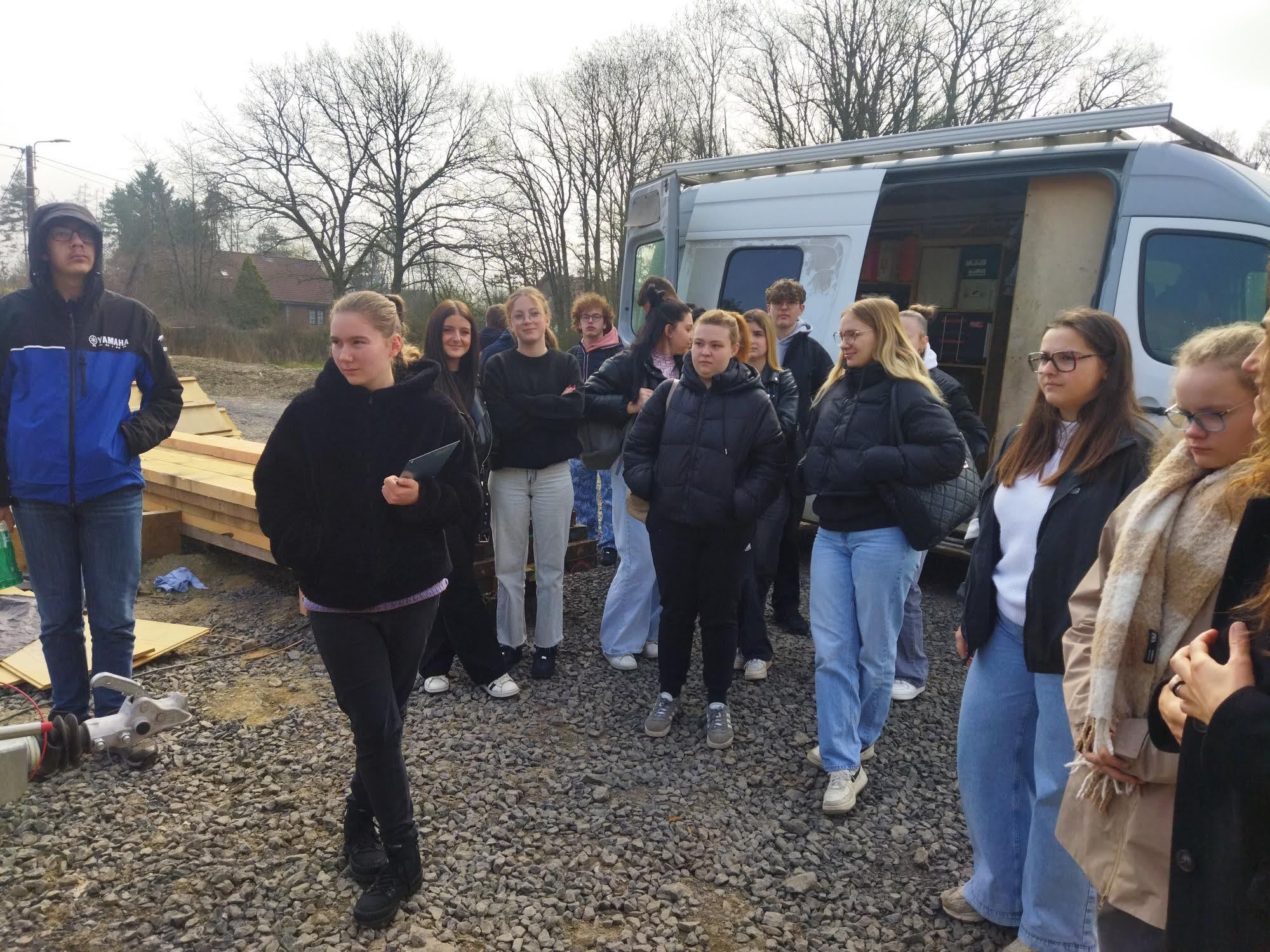
Pilot Project ‘GCE in (T)VET: students from Athénée Royal Rochefort-Jemelle Namur embark on a Journey of Discovery into Food Sovereignty
Pilot Project ‘GCE in (T)VET: students from Athénée Royal Rochefort-Jemelle Namur embark on a Journey of Discovery into Food Sovereignty
BeGlobal launched, in collaboration with Entraide & Fraternité (E&F) and the Athénée Royal Rochefort-Jemelle, a pilot project to strengthen GCE competencies of students in Technical and Vocational Education and Training (T)VET. We did so during the school year of 2024–2025, using concrete case studies under the theme of “food sovereignty.”
The “See – Judge – Act” method lies at the heart of all of Entraide & Fraternité’s projects and served as the guiding thread for every workshop. Throughout this programme, it aimed to encourage students to develop their social skills in order to act on the world, always drawing on their own experiences, while also fostering their active involvement in their own education.
The pilot project pursued two objectives:
- Developing teaching materials specifically tailored to the interests and needs of (T)VET students;
- Encouraging (T)VET students to become responsible citizens.
The second objective was assessed using three indicators:
- The students became more curious as a result of the project;
- The students are considering different prospects than those they had envisaged before the project began;
- The students feel that their self-confidence had grown.
Your ideal world
The pilot project consisted of six sessions with students specifically selected for this project. The students came from various fields of study within the vocational education program at the Athénée Royal de Rochefort-Jemelle high school, ranging from 10th to 12th grade: Sales, Childcare, Masonry, Computer Science, and Teaching Assistant.
“In what kind of ideal world do you want to live in ten to fifteen years?” The project alternated between participatory sessions, individual reflections, and discussion time in the classroom. This multidimensional approach catered to different learning styles and fostered student participation and engagement.
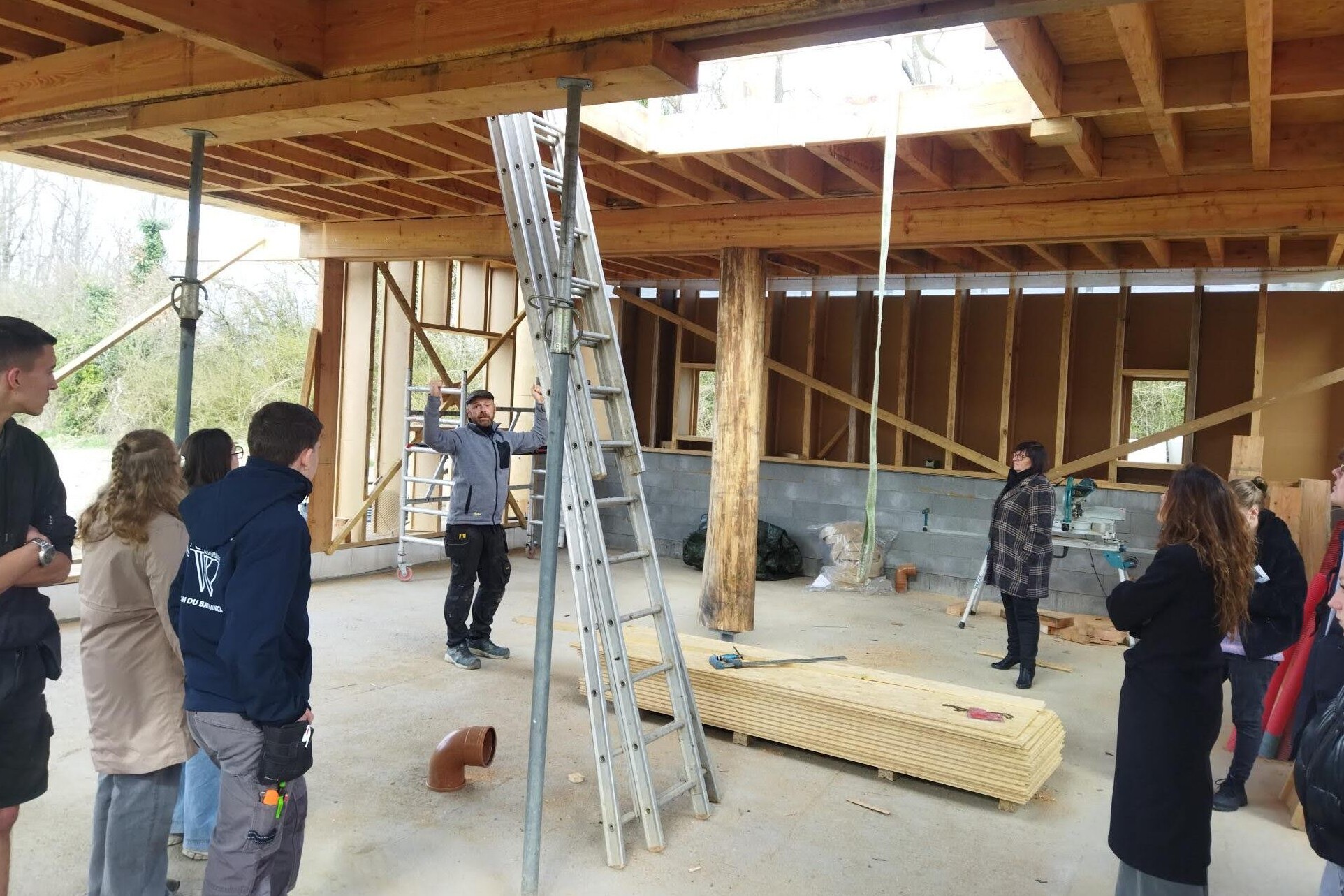
The group also visited real-world work settings, such as an ecological construction site and a local cooperative agroecological farm. There, they had the opportunity to meet people who are themselves thinking about their ideal world and actively bringing in their professional practice. This visit left a deep impression on the students. Afterward, the Masonry students even asked their practical course teachers to take the rest of the class on the same visit.
Self-confidence and curiosity
A significant number of students adjusted their habits and even began encouraging their family and friends to change their consumption patterns and how they interact with vulnerable people. The group raised the idea of going on an immersion trip: something they hadn’t previously considered. Both the teachers and the school psychologist noted a positive shift in terms of self-confidence and curiosity regarding GCE themes.
This impact was assessed based on both a self-evaluation and group discussions. This revealed that students were not always fully aware of the effect the programme had had on them. For example: “Although no student indicated in the self-evaluation that they had become more curious, the majority reported that they had searched for the themes covered during the project on social media, even though they had not done so previously.”
GCE in (T)VET
This program is part of BeGlobal’s “Global Citizenship Education (GCE) in Technical and Vocational Education and Training ((T)VET)” project, which launched two pilot projects during the 2024–2025 school year. Two schools, one on each side of the language border, developed and implemented a GCE pilot project in co-creation with NGOs. A pilot project was also set up in Flanders: a collaboration between KTA CLW Bruges and a consortium of the NGOs Djapo & Studio Globo.
Want to learn more about the pilot project in Dutch-speaking Belgium? Click here!
GCE in (T)VET: the study
The study “Global Citizenship Education in Technical and Vocational Education and Training” was conducted in 2024 on behalf of BeGlobal by a research team from UCLL University College. The goal of the two pilot projects was to test the study’s recommendations against the reality of the school environment. They indeed confirmed the importance of an action-oriented approach, a connection to practical courses, and a link to the students’ lived experience.
Read the study ‘GCE in (T)VET’ here!
Want to learn more about the overarching project ‘GCE in TVET’? Click here!


Youth Sounding Board
Youth Sounding Board: let your voice be heard!
Young people are the key players in the world of tomorrow. To address global challenges more effectively, the narrative and approaches to international cooperation needs to evolve. Therefore, the voice of youngsters must be represented and amplified. This is why we are proud to announce the launch of the Youth Sounding Board, a pilot project of Enabel.
Young people are the key players in the world of tomorrow. To address global challenges more effectively, the narrative and approaches to international cooperation needs to evolve. Therefore, the voice of youngsters must be represented and amplified. This is why we are proud to announce the launch of the Youth Sounding Board, a pilot project of Enabel.
What?
A number of formal meetings with the Corporate Board and preparatory sessions in between. These will be held mainly in English and led by an external facilitator.
For whom?
A selection of external youngsters and internal youth from Enabel (in Brussels and our partner countries), aged between 18 and 32, interested in global challenges and, more specifically, international cooperation and solidarity.
When?
From the beginning of April 2025 until the end of December 2025. This is a one-year pilot and can be extended after evaluation.
Any questions?
Don’t hesitate to contact us through beglobal@enabel.be.

Webinar: "Global citizenship education through the approaches of actors from the South: towards transformative partnerships and a renewal of Western visions"
Webinar: Global citizenship education through the approaches of actors from the South: towards transformative partnerships and a renewal of Western visions
Tuesday March 18, 2025 | 12:30 – 2:00 PM (CET)
Global Citizenship Education (GCE) is a crucial tool for understanding global interdependencies and fostering engagement for a fairer and more inclusive world. But how is it conceived and implemented by actors in the Global South? What challenges and dynamics shape their work?
BeGlobal invites you to a special webinar to explore the findings of the report “Panorama of Global Citizenship and International Solidarity Education Actors in the Global South”.
A Decentered Approach to Renew Our Perspectives
This study, commissioned by AFD in 2024, offers a decentered, non-Western perspective on GCE. It analyzes the diversity of concepts, approaches, and visions for change led by actors in the Global South, shedding light on key dynamics and challenges.
A Dialogue to Strengthen Partnerships
By joining this webinar, you will:
- Discover innovative practices and perspectives from the Global South;
- Challenge dominant models and enrich your approach to GCE;
- Reflect on fairer and transformative partnerships.
- Date: March 18, 2025
- Time: 12:30 – 2:00 PM (CET)
- Language: French, with simultaneous English translation
Practical Information
Read the full report here (FR): AFD – Panorama des actrices et acteurs de l’ECSI aux Suds
Join us to rethink the challenges and practices of Global Citizenship Education together!


Strengthening Global Citizenship Education in Technical and Vocational Education and Training
Why GCE in (T)VET?
Our world is becoming increasingly globalized and interconnected. This brings opportunities, but also complex challenges for future generations. It is therefore only natural that young people seek the knowledge and skills to understand complex problems, adapt, and find solutions together. Global citizenship education offers an answer to this need, as it provides young people with the tools and knowledge they require in their quest for a fairer and more sustainable world.
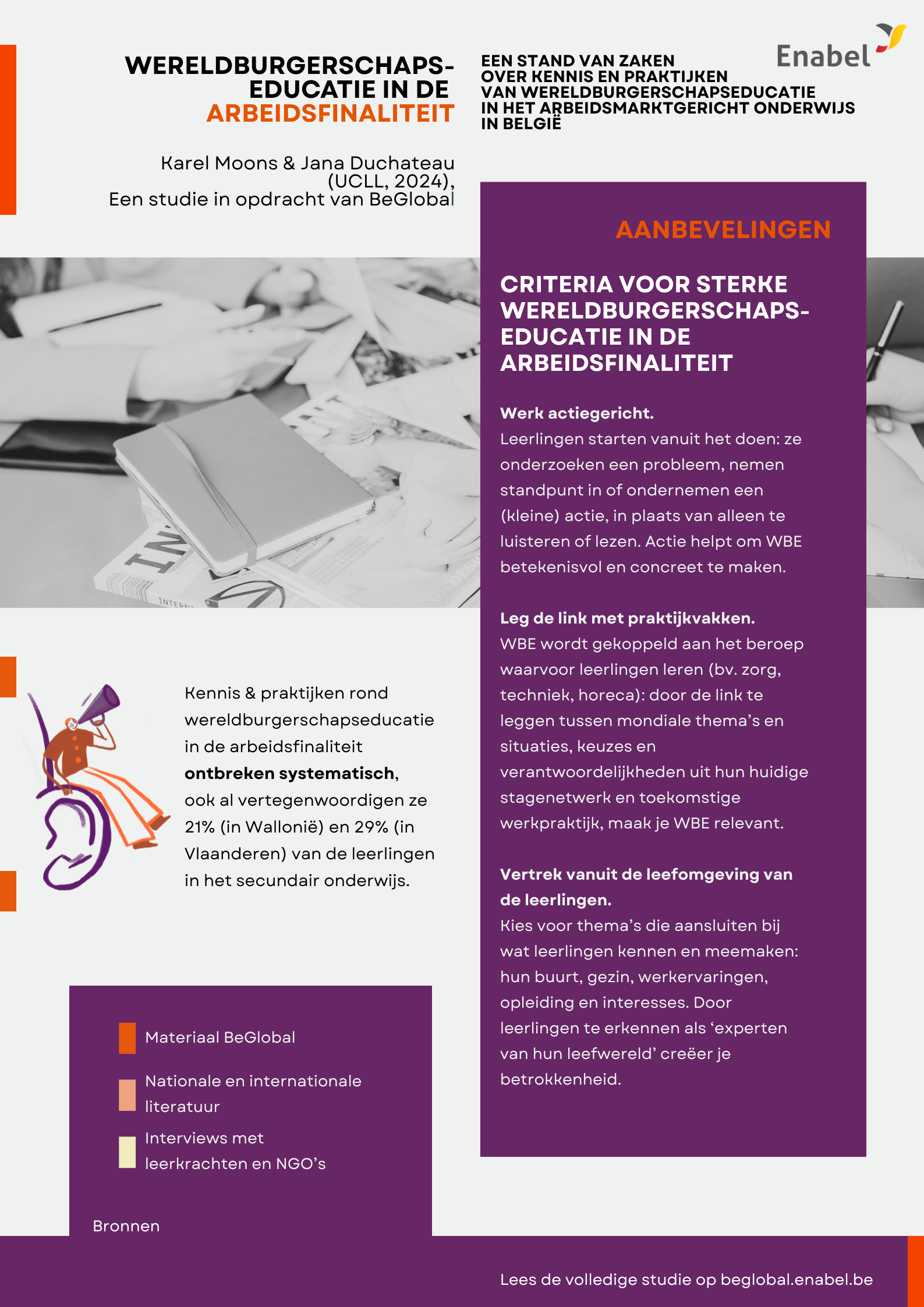
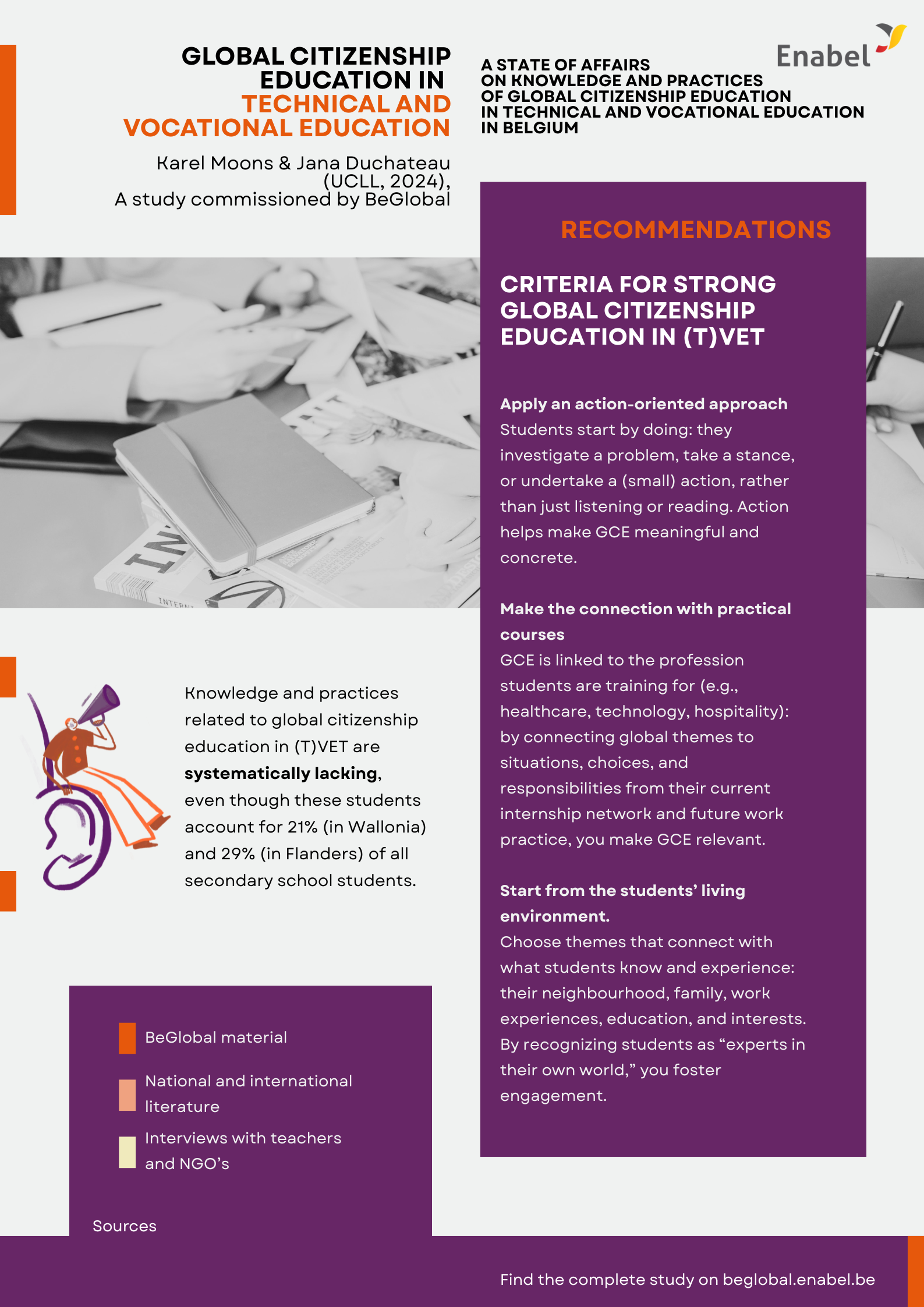
The DGD’s strategic note on global citizenship education in Belgium (available in Dutch and French) emphasizes the urgency and importance of integrating GCE skills into all streams. (T)VET students are explicitly identified as a target group under the motto ‘Leave No One Behind’, as they have less exposure to GCE activities, even though they represent 21% of secondary school students in Wallonia and 29% in Flanders. This is because GCE practices and methods are typically developed for students in general education.
More specifically: how? / Where are we coming from?
The study
Global Citizenship Education in Technical and Vocational Education and Training
Community of Practice
Reflecting together about GCE in the (T)VET
Pilot project in Flanders
Kapt Ermee!
Pilot project in Fédération Wallonie-Bruxelles
Oh purée, on a la patate !
2030
A key finding from the study is that knowledge and practices regarding GCE in (T)VET are systematically lacking. GCE actors, teachers, and schools play an important role, but need knowledge and tools specifically designed for (T)VET settings. With this project, BeGlobal aims to bridge that gap.
The study: a state-of-affairs review of GCE knowledge and practices in (T)VET
The study “Global Citizenship Education in Technical and Vocational Education and Training” was conducted in 2024 on behalf of BeGlobal by a research team from UCLL University College. It provides an overview of national and international literature, complemented by interviews with NGOs and teachers on the current state of and challenges facing global citizenship education in (T)VET in Belgium.
The study confirms what the LNOB principles also emphasize, like the importance of experiential learning, and that it is essential to view and treat students as fully capable and empowered participants in a co-creation process and not merely as a target group. The study confirms that when students are given the opportunity to decide, create, test, and use their voice, their engagement and motivation increase. In this way, global citizenship education, provided with the right approach is taken, can become a space for dialogue and a lever for empowerment.
Two pilot projects
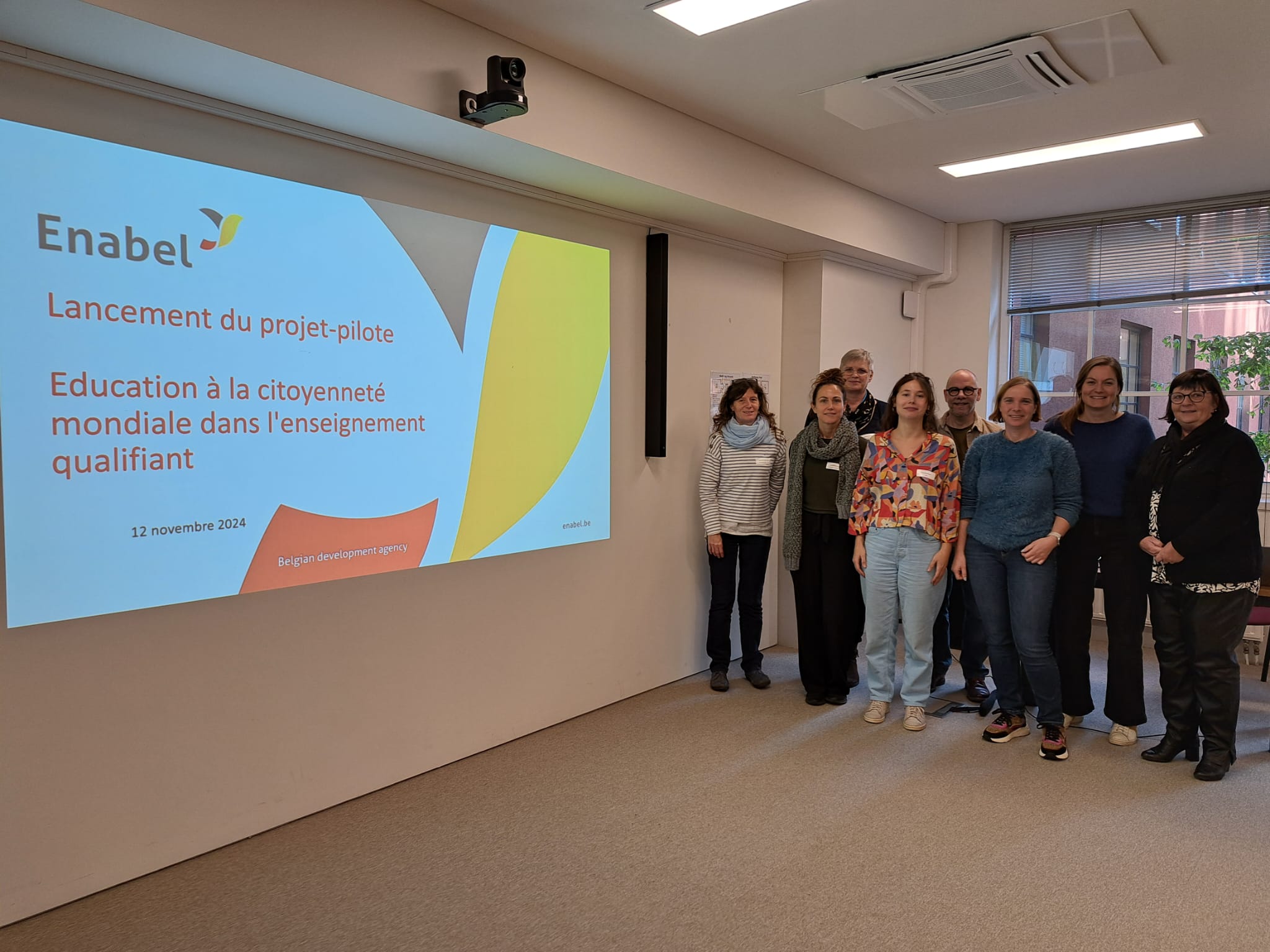
During the 2024–2025 school year, a GCE pilot project in (T)VET schools was launched on both sides of the language border. In Flanders, the KTA Centre for Dual Learning in Bruges collaborated with a NGO consortium Djapo and Studio Globo. In Wallonia-Brussels, the Athénée Royal Rochefort-Jemelle was supported by Entraide & Fraternité. The goal was to test the study’s recommendations against the reality of the school environment.
The pilot projects indeed confirmed the importance of:
- Action-oriented learning. Students start by doing: they investigate a problem, take a stance, or undertake a however small concrete, action, rather than simply listening or reading. Acting helps make GCE meaningful and tangible.
- Making the connection with practical courses. GCE is linked to the profession students are training for (e.g., healthcare, technology, hospitality): by drawing connections between global issues and the situations, choices, and responsibilities from their current internship network and future work practice, GCE becomes genuinely relevant.
- Starting from the students “lived experience”. Choose themes that resonate with what students know and experience in their daily lives: their neighbourhood, family, work experiences, education, and interests. By recognizing students as “experts in their own world,” you foster both engagement and sense of ownership.
What’s next? Community of Practice
Building on the findings from the study and the pilot projects, we aim to launch an action research and action pathway in the form of a Community of Practice (CoP). This will be a space for regular encounters where organisations, teachers, and experts learn together to strengthen global citizenship practices in (T)VET, spotlight inspiring approaches and methods, and build a shared body of knowledge:
- Embedding GCE in technical and vocational education;
- Disseminating the knowledge and practices gathered to all stakeholders in the GCE and (T)VET sectors.
Be part of this collective journey of reflection and discovery. Reach out to us at: beglobal@enabel.be.

SoliDare Festival
Come out there and meet the world!
SoliDare Fest is back in Brussels on 14 and 15 February. This one-of-a-kind festival, organized by and for young people is open to anyone aged 16 to 30 to discover international solidarity and its many dimensions over two days. Do you want to offer your pupils/students a unique opportunity to meet and learn from interesting people as part of a school trip? Then mark Friday 14 February on your calendar.
What is SoliDare Fest?
An educational, inspiring and enriching festival that boost young people’s critical and citizenship mindsets. It is an occasion to get to know NGOs, international organisations and committed young people from all over Belgium.
Young people can explore and discuss challenges such as the environment, decolonisation and socio-economic and gender inequalities.
Programme
The festival will take place on Friday 14 and Saturday 15 February from 10 am to 6.30 pm, with a similar programme on both days:
- Inspirational debates: a reflection on the future of international solidarity with young people by SoliDare, a roundtable discussion between young people and key figures in official international cooperation and a debate on the role of young people in official NGOs with the CNCD-11.11.11.
- Various workshops:
- Martial Arts for Peace by We See You
- Traditional Afar singing and dancing by FIDA
- Fast fashion reflection through screen printing by Latitude Jeunes
- And many more, led by various actors and NGOs working on global citizenship education (WBE) and international solidarity: Broederlijk Delen, Djapo, KIYO, CNAPD, YOUCA, UCOS, VLIR-UOS, UHasselt, ARES, Jagora, Join for Water, WSM, Bibliothèques Sans Frontières, Défi Belgique Afrique, 11. 11.11, CNCD-11.11.11, Oxfam Solidarity, IOM, CEC, 4th Pillar Support Centre, Enabel Junior Program, Diocese Kasongo, …
- Numerous info stands for young people on volunteering, career opportunities in international cooperation, activism and so on.
- Interactive art installations: painting in collaboration with the Palestinian artists of A Land With A People and the VR experience of Draw for Change.
- Meetings with young activists by Intal and young people from Amnesty International
- Theatre: ‘Le passe tête’, the touching testimony of an immigrant without papers
- Exhibitions: KABA Art Initiatives, Draw for Change and a short documentary on reforestation in Rwanda
- Music: various concerts, keep an eye out!
- And of course, there will be plenty of opportunity to enjoy delicious dishes that taste of international solidarity. These will be prepared by Brussels-based caterer, Ben’s Tables.


Where and when?
At Capital asbl/vzw, Antwerpselaan 40, 1000 Brussels
- 14 February 2025: for schools and pupils/students aged 16 and older
- 15 February 2025: for all young people aged 16 to 30
Are you an engaged teacher?
Do you want to encourage your pupils/students to engage in international solidarity? Participate with your class or teaching group in SoliDare Fest on Friday, 14 February! Register your class/lesson group now via the link below and encourage your pupils/students to build a more inclusive future.👇
Do you have questions?
Don’t hesitate to contact us through beglobal@enabel.be.