Mapping: youth engagement and international solidarity

NL


An overview of organisations working with youth on international solidarity

Today’s youth want to make a difference in promoting greater justice, solidarity, and a sustainable future. BeGlobal therefore wants to map out the activities and experiences of organizations working with youth aged 16 to 35 on international solidarity.


Why mapping youth engagement and international solidarity?

Young people in Belgium are growing up in a rapidly changing world with major social challenges such as polarisation, climate change, increasing social inequality, geopolitical tensions and digital transformation. At the same time, they show a great willingness to get involved and make a difference.

This engagement often arises outside the school walls within what is known as non-formal learning. Think of youth organisations, socio-cultural associations, sports and cultural initiatives, NGOs and local youth initiatives and networks. These actors play a crucial role: they reach young people in an accessible way and are closely connected to their world.

However, there is currently no up-to-date and comprehensive overview of who reaches young people, how this is done and how organisations work on global issues and international solidarity.

BeGlobal wants to change this. This mapping helps to bring together insights from the field and contributes to a better coordinated policy on youth engagement, global citizenship education and international solidarity in Belgium.


What do we want to identify with this mapping?

The mapping is about having an overview of organisations, collectives and initiatives that work within non-formal learning with young people on international solidarity.

With this mapping, we identify:

  • who these actors are,
  • how they work (explicitly or implicitly) on international solidarity and global citizenship,
  • how they raise awareness and mobilise young people around global issues,
  • which young people are reached (and which are not),
  • what forms of engagement and methodologies are used,
  • and what trends, needs and opportunities organisations experience in their work.


Who is included in the mapping?

Everyone who works within non-formal learning with young people aged 16 to 35 on global citizenship and/or international solidarity, in all regions of Belgium, such as:

  • Youth organisations
  • NGOs and civil society organisations
  • Diaspora organisations
  • Socio-cultural organisations
  • Sports and cultural organisations
  • Media
  • Private organisations or foundations
  • Local, regional and international authorities


How are we going to do this?

Through an online survey or an online (in-depth) interview.

The results and findings will subsequently be available on our website.

Any questions?

Feel free to contact us at mapping@enabel.be

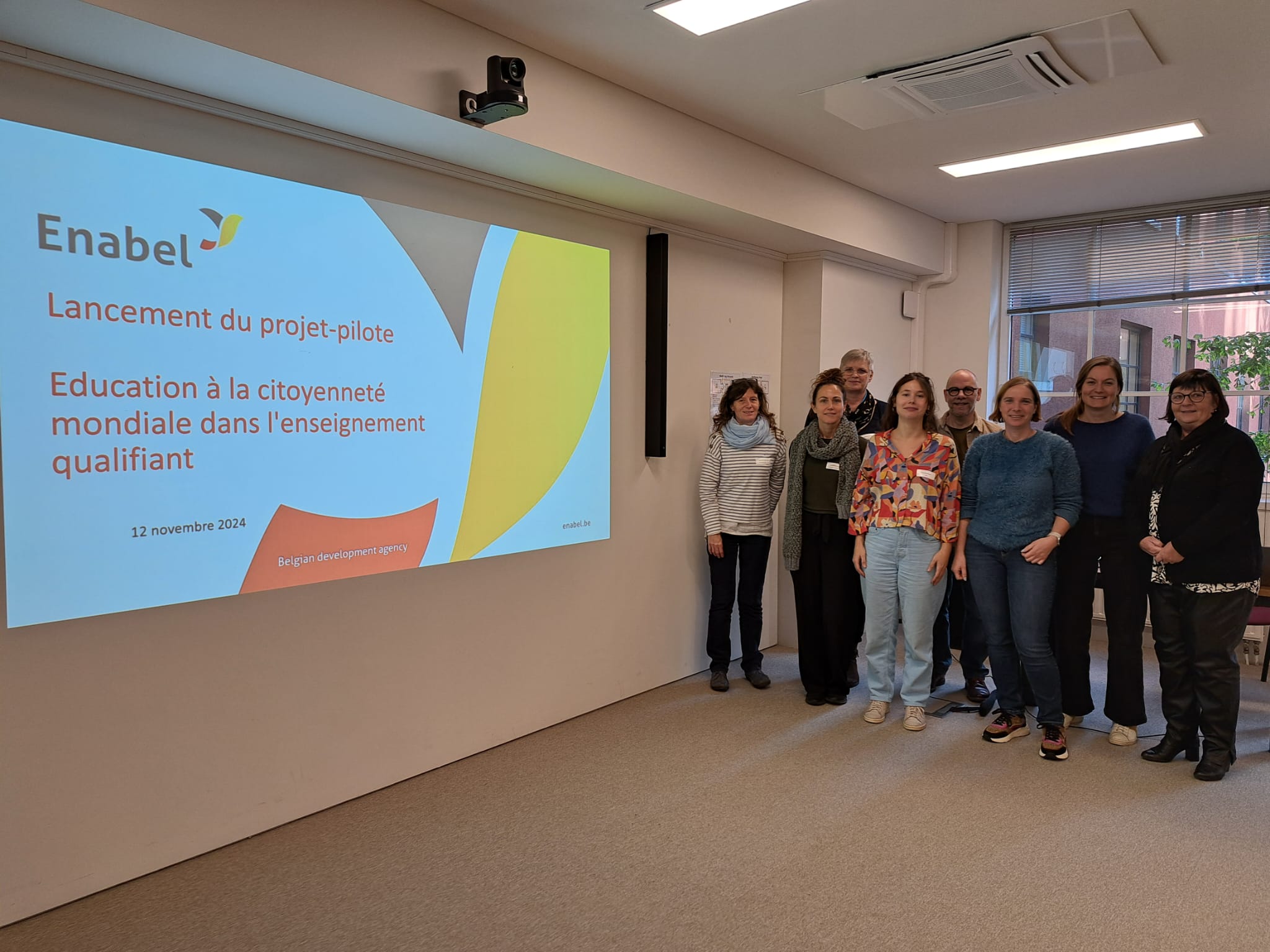
Pilot Project on GCE in Vocational Education


NL

Rochefort-Jemelle Youth Explore Food Sovereignty 

Introduction

To build a fair and equitable future for all, critical thinking and global awareness must be taught to today’s youth. BeGlobal seeks to equip young people with the tools and knowledge they need to become conscious and engaged citizens, capable and enthusiastic to actively participate in their communities. Strengthening Global Citizenship Education (GCE) in teaching is one of the relevant initiatives within this mission. As noted in the study conducted by our partners at UCLL, students in vocational education are often a neglected audience in GCE projects.

In cooperation with Entraide & Fraternité (E&F), an international solidarity NGO, and the Athénée Royal Rochefort-Jemelle, a school in the province of Namur, BeGlobal facilitated a pilot project to strengthen GCE skills among young people in vocational education.

Project objectives

With two objectives in mind, the pilot project sought to:

  1. Adapt teaching materials to spark the interest of vocational education students, and;
  2. Encourage young people in vocational education to become responsible citizens.

Three indicators of success were established by E&F to assess progress toward the second objective. These were:

  1. Students became more curious as a result of the project;
  2. Students are considering futures other than those they had in mind before the project began;
  3. Students feel their self-confidence has grown.

The theme that was used to explore GCE with the Rochefort-Jemelle students is the concept of ecological and just transition. More specifically, this theme was explored through the lens of food sovereignty.

The “See – Judge – Act” method, which “is the DNA of all projects carried out by E&F,” was used to guide each training session for students throughout the project. This method aims to train individuals in social action and transforming the world based on their personal experiences and by actively involving individuals in their own learning and reflection.  

Putting the project into action

The project took place from February to May 2025, in the form of six meetings with the students selected for this initiative. The youth, all between the 4th and 6th years of secondary school, came from different specializations: sales, childcare, masonry, IT, and education.

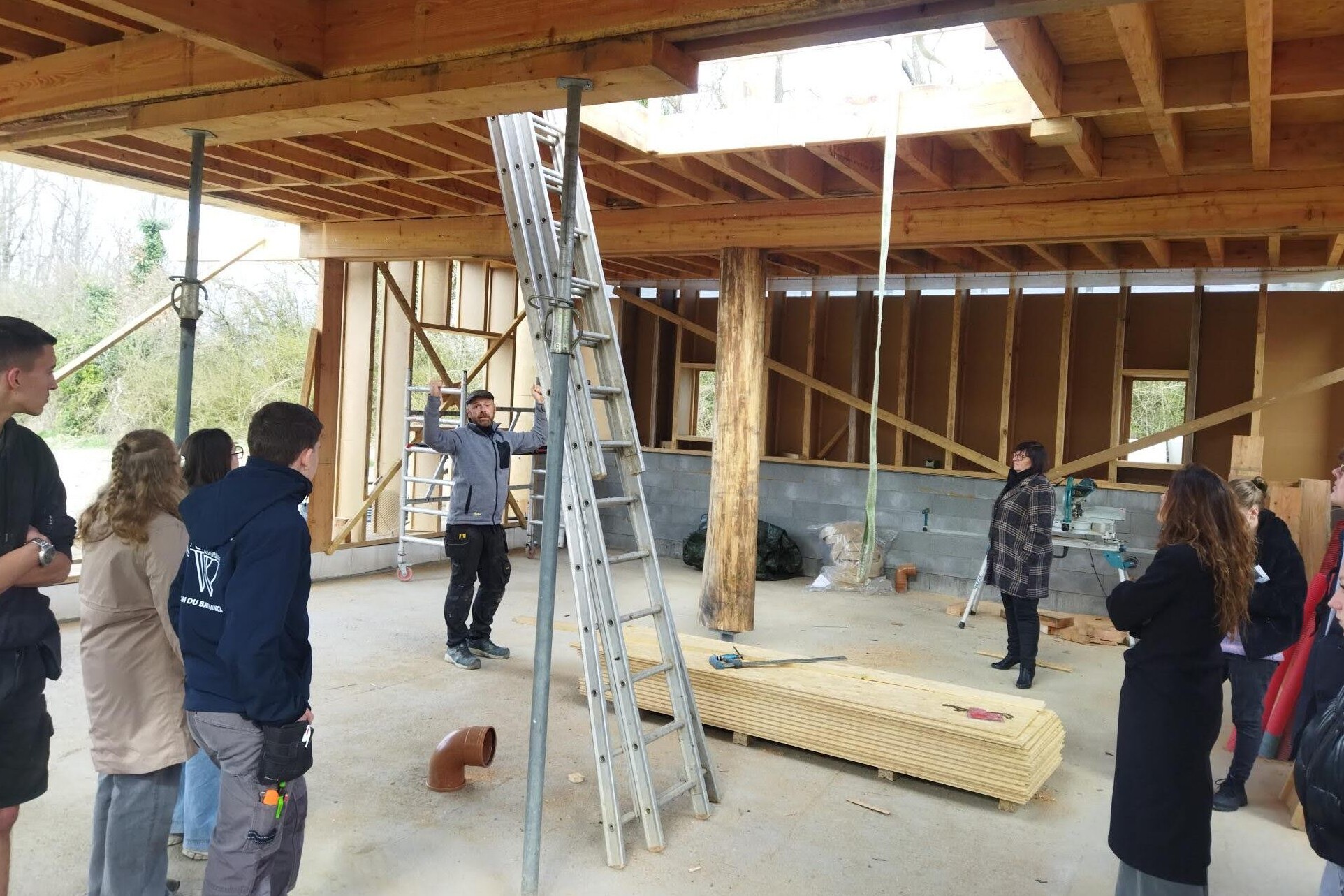
The project, led by E&F, alternated between participatory thematic classroom sessions, individual reflections, field visits — including an eco-construction site and a local cooperative — and opportunities for sharing.

This multidimensional approach drew on different learning styles and facilitated student participation and engagement.

For example, during the fourth meeting, students were encouraged to think about the ideal world in which they would like to live in 10 to 15 years. This activity was based on the pillars of change explored in a previous session, meaning that students had already acquired the knowledge and resources to participate in this reflection, which took place in small groups. 

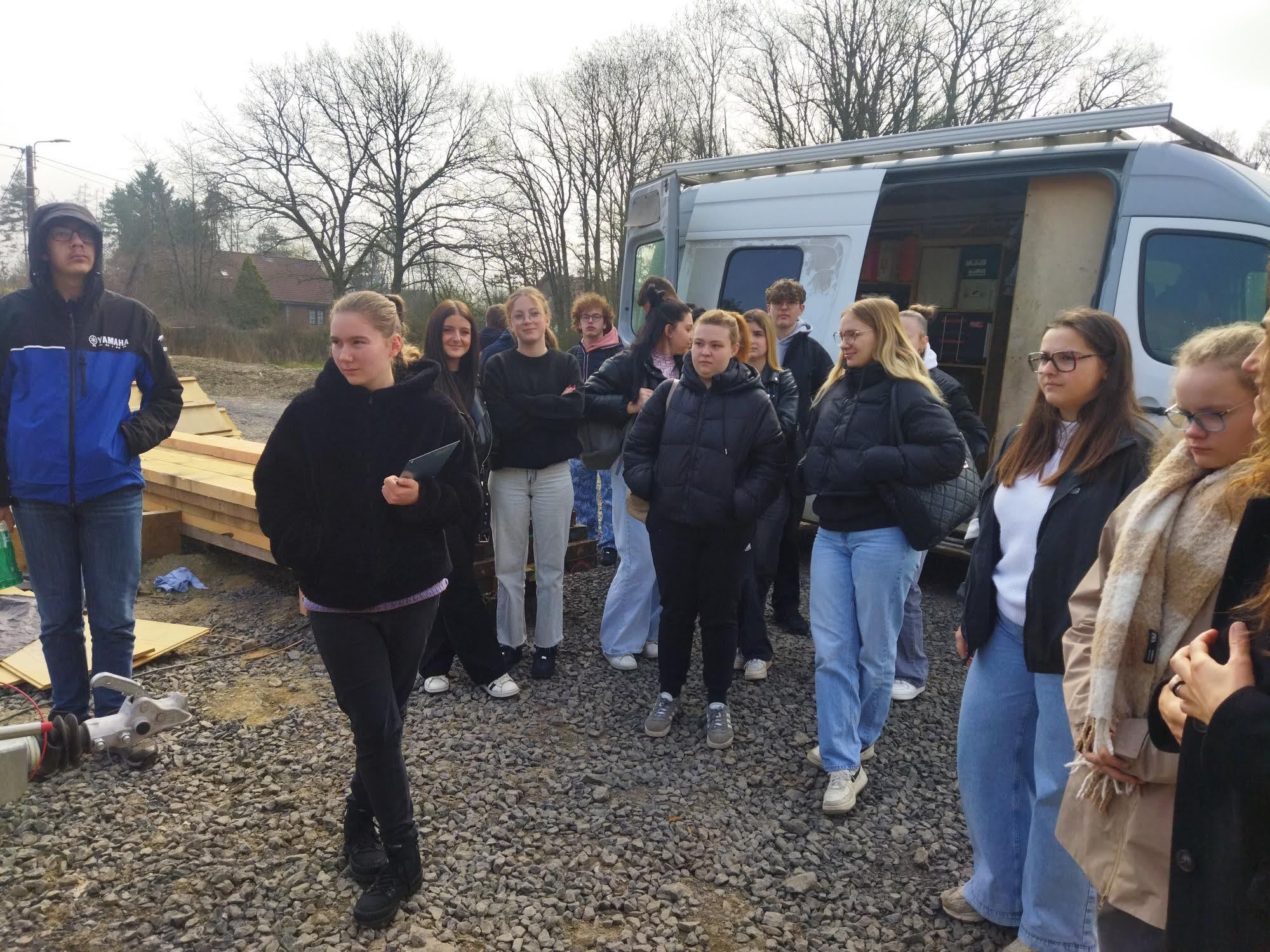
Following this exercise, the young people visited an eco-construction site and an agroecological farm —visits that allowed them to meet people who had thought about their ideal world and were implementing it with their own hands.

This visit had a profound impact on the group. The students in the masonry program even asked their teachers to take them back after the pilot project ended, inspired by this encounter and by the immersion in the field.

Results

The results of the pilot project are very positive overall. To assess the impact on the students, two different evaluations were carried out.

The first evaluation session, Self-Positioning within Space, was conducted using a self-assessment format. This was carried out with the entire group, and the students were able to see their classmates’ reflections. This public self-assessment format led to a very pronounced group effect. According to this evaluation session, there was only a slight change in the curiosity and self-confidence levels of the young participants.

The second assessment methodology was used to complement Self-Positioning within Space. The World Cafe gave young people the opportunity to discuss topics in small groups, divided by theme. Each discussion station asked students what they thought, did, or plan to do differently after participating in the project. The results of this evaluation were very positive and contradicted several results of the Self-Positioning within Space evaluation. For example, “while no students reported feeling more curious in the first evaluation, the majority reported having researched the topics covered during the project on social media (which they had not done before).”

Overall, many students have changed their habits in their personal lives or are advising their family and friends to change their consumption habits and think about their relationships with more vulnerable people. Several students have indicated that they want to go on humanitarian trips because of the project, something that the youth did not consider before. Teachers and the school psychologist observed changes in the students in terms of self-confidence and the development of curiosity regarding the themes explored with eh use of GCE.

Conclusion

The success of the project can be measured through the achievement of the two key objectives set at the start of the process, but especially through the visible positive effects the project had on the participating students. The cooperation established between BeGlobal, Entraide & Fraternité, and the Athénée Royal Rochefort-Jemelle has had a positive influence on the youth in the program and has demonstrated that TVET students should not be overlooked when developing GCE initiatives to train and support the next generation in Belgium.

Global Citizenship Education in vocational education

As part of the “Global Citizenship Education (GCE) in vocational education” project, two pilot projects were launched during the 2024-2025 school year.

Two schools, each located on either side of the linguistic border, developed and implemented a GCE pilot project in collaboration with NGOs. In Flanders, KTA CLW Bruges collaborated with the DjapoStudio Globo consortium. In Wallonia-Brussels, a pilot project was also set up: a collaboration between Athénée Royal Rochefort-Jemelle and Entraide & Fraternité.

Would you like to find out more about the two pilot projects?

The two pilot projects put into practice the recommendations that were drafted by our colleagues at the UCLL, who are the authors of the study “GCE in vocational education.”

Would you like to find out more about the study?

Would you like to find out more about the study?

The project thus aims to contribute to the implementation of concrete measures to address global citizenship education with young people in vocational education, in order to motivate them and raise their awareness of the need to commit to a fairer and more sustainable world. 


Click here for more information about the study

Citations

Enabel. (2025). Projet de renforcement de l’éducation à la citoyenneté mondiale dans l’enseignement qualifiant – 2024-2025. Rapport d’évaluation. Entraide & Fraternité en collaboration avec l’Athénée Royal Rochefort-Jemelle.

Would you like to stay informed?

Contact Paulien Caeyers at paulien.caeyers@enabel.be


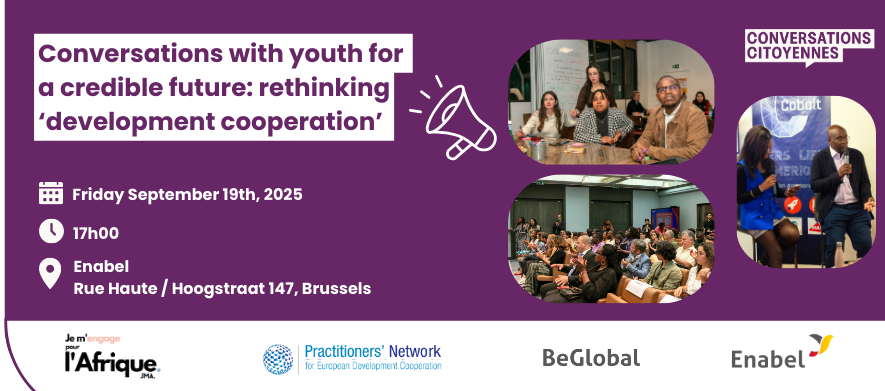
Conversations with youth for a Credible Future: Rethinking “development cooperation”

NL

19/09/2025

📅Friday September 19, 2025
⏰5 PM – 9 PM
📍Enabel, Rue Haute 147, 1000 Brussels (Hybrid: in person and online)
🗣 English & French (translation available)

💬 A call for critical reflection and dialogue 

Why this event?

Official development assistance (ODA) is under unprecedented pressure. Deep budget cuts and declining public support are driving the sector through a period of transition. In this context, Je m’engage pour l’Afrique (JMA) and BeGlobal invite you to Brussels on September 19, 2025, for two important conversations about the future of official development assistance.

In January 2025, the sudden suspension of USAID shook the international development world. In Europe, ODA is also under fire: -35% in France, -25% in Belgium, and up to -66% in the Netherlands by 2027. These cuts affect lives worldwide and threaten global solidarity. 

But: is ODA still relevant? Should it be reformed or completely reimagined? And how can citizens be involved in this critical conversation? 

I'm joining!

🗣Two key discussions:

Conversation 1 – A distant reality of citizens: is ODA still worth supporting? 

ODA is often misunderstood in the public discours. It’s not a simple form of aid asit involves loans, partnerships, and long-term strategies. We’ll unpack the political and historical roots of ODA and set the stage for a deeper debate. This first discussion raises the key questions that will be addressed in the second conversation. 

Conversation 2 – International cooperation in crisis: reallocate resources or change the paradigm? 

And now? What are the alternatives? From new financing mechanisms, innovative partnerships, epistemic justice, local ownership and fair partnerships… This session will explore new pathways for a more just, effective, and sustainable international cooperation. 

📌Programme

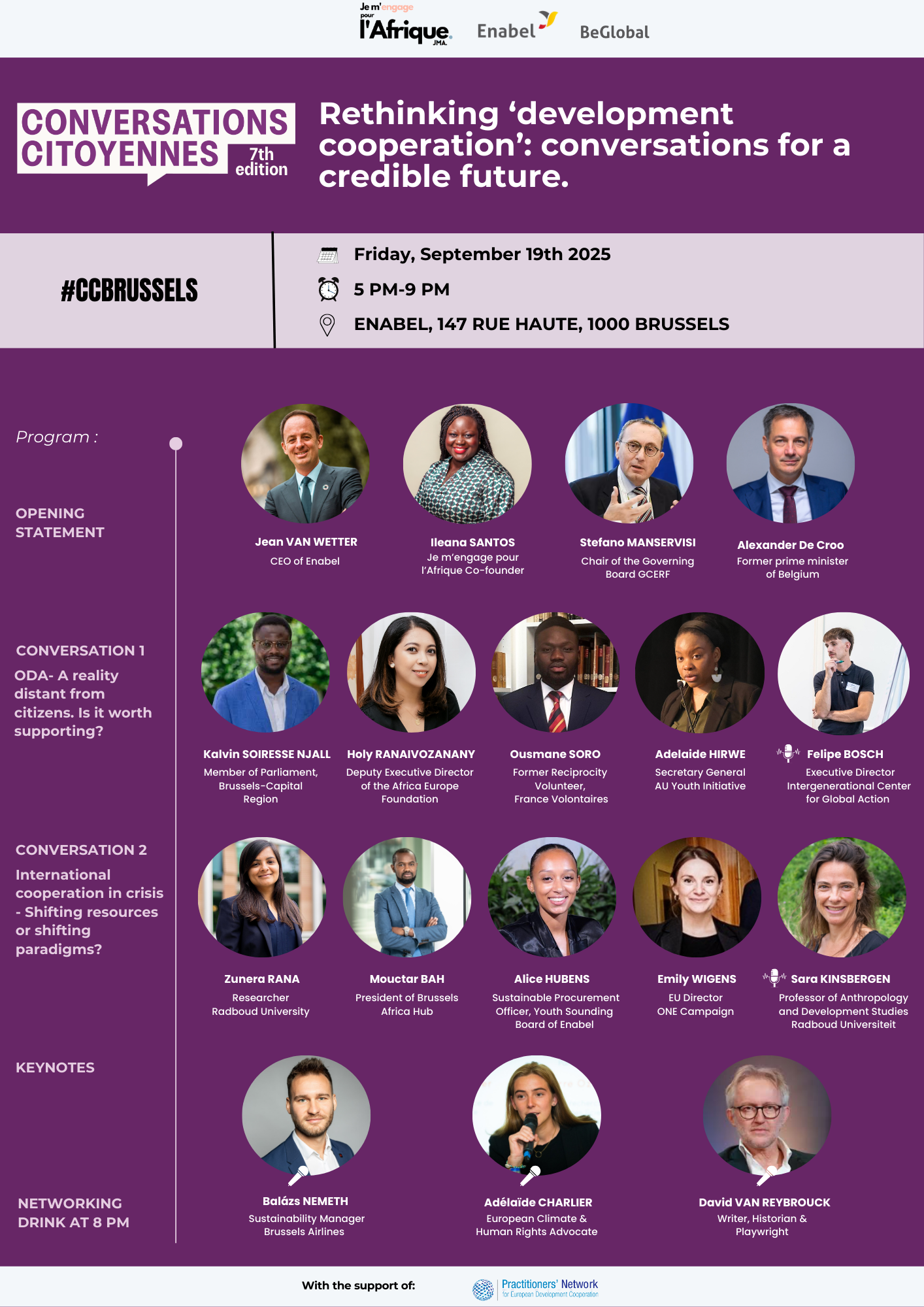
17h – Introduction

  • Jean VAN WETTER – CEO Enabel
  • Ileana SANTOS – Co-founder Je m’engage pour l’Afrique
  • Stefano MANSERVISI – Chair of the Governing Board GCERF
  • Alexander DE CROO – Former prime minister of Belgium

Conversation 1 – A distant reality of citizens: is ODA still worth supporting? 

Panelists

  • Kalvin SOIRESSE NJALL – Member of Parliament, Brussels-Capital Region
  • Holy RANAIVOZANANY – Executive Director of the Africa Europe Foundation
  • Ousmane SORO – Former Reciprocity Volunteer, France Volontaires
  • Adelaide HIRWE – Secretary General AU Youth Initiative

Moderator

Felipe BOSCH – Executive Director Intergenerational Center for Global Action 

Conversation 2 – International cooperation in crisis: reallocate resources or change the paradigm? 

Panelists

  • Zunera RANA – Researcher Radboud University
  • Mouctar BAH – President of Brussels Africa Hub
  • Alice HUBENS – Sustainable Procurement Officer / Youth Sounding Board of Enabel
  • Emily Wigens – EU Directer ONE Campaign

Moderator

Sara KINSBERGEN – Professor of Anthropology and Development Studies Radboud Universiteit

Keynote

Balázs NEMETH – Sustainability Manager Brussels Airlines 

Adélaïde CHARLIER – European Climate & Human Rights Advocate

Conclusion

David VAN REYBROUCK – Writer, Historian & Playwriter

20-21h – Reception
For who?

Students, young changemakers, professionals, activists, entrepreneurs, or curious citizensthis event is for everyone, with a with a special focus on youth-led perspectives and participation. 

📍 Practical

  • Location: Enabel, Rue Haute/Hoogstraat 147, Brussels 
  • Date & time : September 19, 2025 from 5 PM to 9 PM
  • Format: hybrid (in-person + online) 

🤝 Organised by

Je m’engage pour l’Afrique 
JMA is a non-political association that supports engaged citizens, project coordinators, association representatives, and entrepreneurs in valuing their experiences, formulating concrete policy proposals, and actively participating in public debate. 

Practitioners’ Network
Organised in the context of Enabel’s co-presidency (together with SIDA) of the Practitioners’ Network, the platform of European international cooperation agencies. 

BeGlobal – Enabel
BeGlobal is Enabel’s youth porgramme, through global citizenship education, it fosters youth engagement for a more just and sustainable world. 

Be part of the conversation that will shape the future of public development aid!

I'm taking part of it!

Youth Sounding Board

Youth Sounding Board


NL

FR, NL


Youth Sounding Board: let your voice be heard!

Young people are the key players in the world of tomorrow. To address global challenges more effectively, the narrative and approaches to international cooperation needs to evolve. Therefore, the voice of youngsters must be represented and amplified. This is why we are proud to announce the launch of the Youth Sounding Board, a pilot project of Enabel. 

Young people are the key players in the world of tomorrow. To address global challenges more effectively, the narrative and approaches to international cooperation needs to evolve. Therefore, the voice of youngsters must be represented and amplified. This is why we are proud to announce the launch of the Youth Sounding Board, a pilot project of Enabel.


What?

A number of formal meetings with the Corporate Board and preparatory sessions in between. These will be held mainly in English and led by an external facilitator.

For whom?

A selection of external youngsters and internal youth from Enabel (in Brussels and our partner countries), aged between 18 and 32, interested in global challenges and, more specifically, international cooperation and solidarity.

When?

From the beginning of April 2025 until the end of December 2025. This is a one-year pilot and can be extended after evaluation.

Any questions?

Don’t hesitate to contact us through beglobal@enabel.be.


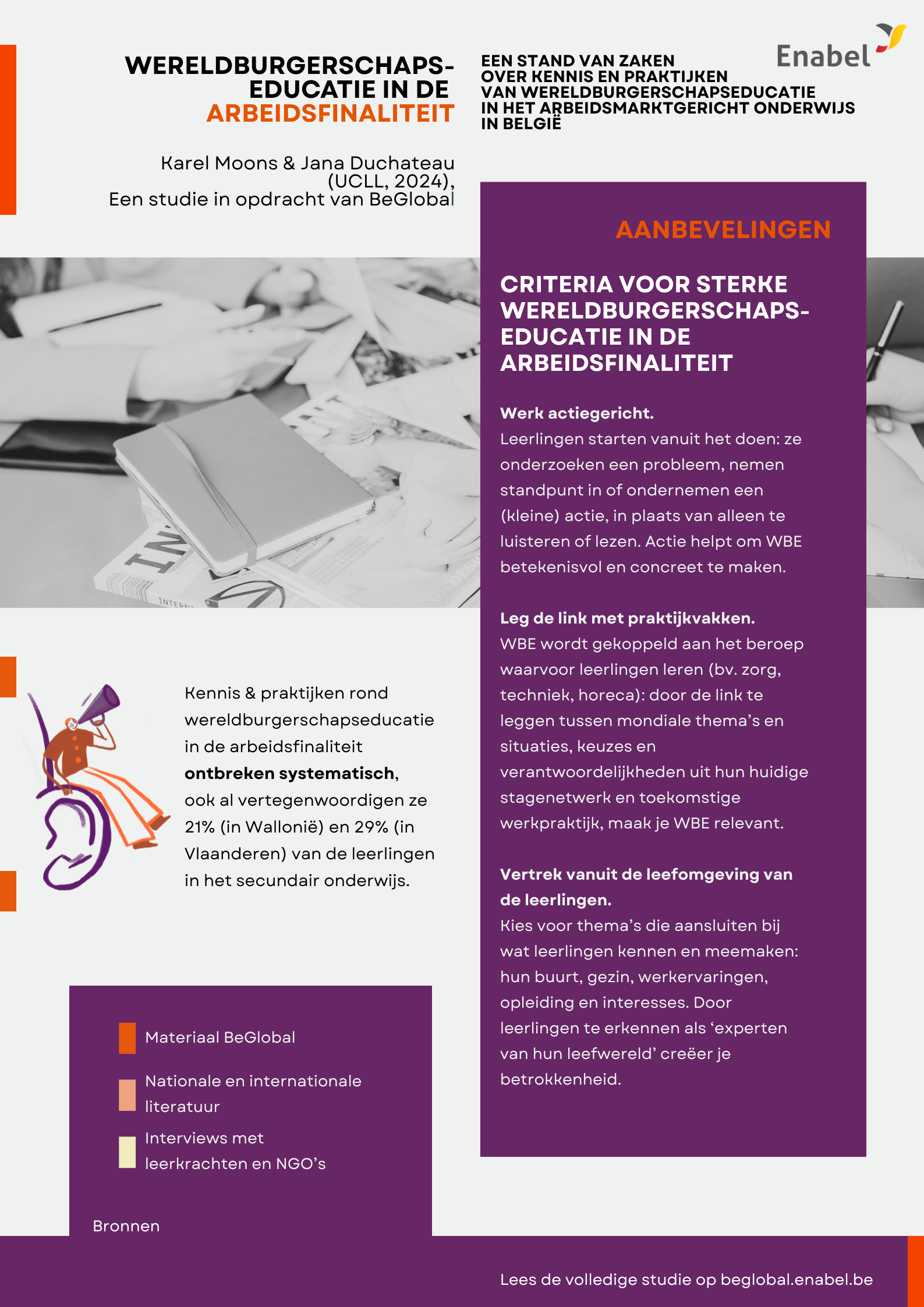
WBE versterken in arbeidsmarktgericht onderwijs

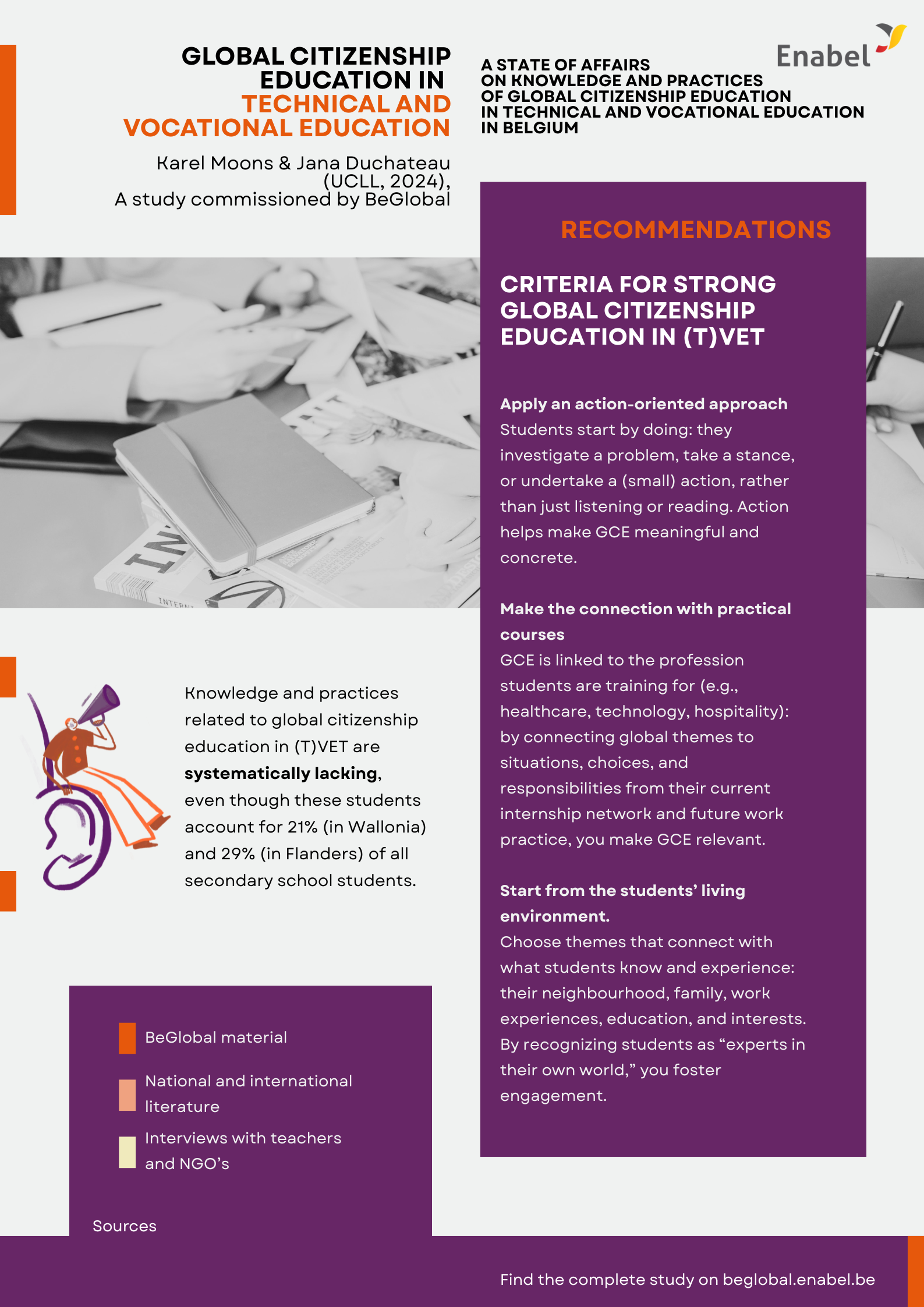
GCE in (T)VET: Global Citizenship Education in Technical and Vocational Secondary Schools

Why strengthen GCE in (T)VET?

Youngsters today are exposed to an increasingly globalised and interconnected world. Globalisation brings opportunities, but also complex challenges for future generations. 2Therefore it is not without reason that young people demand to be equipped with the knowledge and skills that are needed to understand complex problems, to adapt, to find solutions and to engage with others. 

Global Citizenship Education (GCE) can be an answer to their demand as it stimulates the potential of young people in their quest for a fairer and more sustainable world. This is all the more true for youngsters in technical and vocational schools, where they, as future professionals, need to demonstrate skills such as flexibility, critical thinking and creativity. 

Past research by BeGlobal has already shown that GCE practices and methods are mostly developed for general education. Moreover, research (e.g. ICCS, 2016) points to a gap between citizenship skills in general education and (T)VET. In technical and vocational secondary schools, a practical approach is essential. 

To prepare youngsters in Belgian (T)VET education for this changing and increasingly complex world, BeGlobal seeks:

      • to understand the needs of these learners and schools,
      • to strengthen bridges between (T)VET schools and Belgian GCE actors,
      • and test out new methods and practices in pilot projects. 

So, how?

By taking stock of knowledge on GCE in (T)VET, by testing new approaches and methods with key stakeholders – schools, students and external partners (NGOs) – and by coming together to learn and get inspired! Three parts of the project should reinforce each other and aim to acquire and share knowledge, in order to enhance a sustainable impact. 

The desk study

Current state of knowledge on GCE in (T)VET

The study was conducted by a research team from UCLL-Hogeschool. This review of national and international literature, complemented by interviews with NGOs and teachers on the current state and challenges of global citizenship education in technical and vocational education in Belgium. The study also provides recommendations to set up a GCE initiative in (T)VET education. 

Go to study results

Two pilot projects

Testing new approaches and methods

A roadmap and good practices emerged from the study’s recommendations. Using these, two schools, one in Wallonia-Brussels and one in Flanders, are creating a new GCE initiative. They are doing so together with pupils and in co-creation with NGOs. 
The pilot projects have two main objectives: 

    • Foster innovation: develop and test new methods and practices to improve students’ GCE skills in technical and vocational education;  
    • Testing a hypothesis: “If a GCE initiative starts from the school’s needs and challenges , does that help strengthen GCE in (T)VET?”

Go to pilot projects

The Community of Practice

Coming together to learn and get inspired

This network aims to bring together different actors from the TVET and the GCE sector. The goal of the CoP is to create space to share experiences and knowledge on global citizenship education in technical and vocational education. 

The Community of Practice hasn’t been created yet.

Want to know more?

Don’t hesitate to contact beglobal@enabel.be!


Logo SoliDare Fest

SoliDare Festival


NL

14-15/02/2025

Come out there and meet the world!

SoliDare Fest is back in Brussels on 14 and 15 February. This one-of-a-kind festival, organized by and for young people is open to anyone aged 16 to 30 to discover international solidarity and its many dimensions over two days. Do you want to offer your pupils/students a unique opportunity to meet and learn from interesting people as part of a school trip? Then mark Friday 14 February on your calendar.

What is SoliDare Fest?

An educational, inspiring and enriching festival that boost young people’s critical and citizenship mindsets. It is an occasion to get to know NGOs, international organisations and committed young people from all over Belgium.

Young people can explore and discuss challenges such as the environment, decolonisation and socio-economic and gender inequalities.

Programme

The festival will take place on Friday 14 and Saturday 15 February from 10 am to 6.30 pm, with a similar programme on both days:

  • Inspirational debates: a reflection on the future of international solidarity with young people by SoliDare, a roundtable discussion between young people and key figures in official international cooperation and a debate on the role of young people in official NGOs with the CNCD-11.11.11. 
  • Various workshops:
    • Martial Arts for Peace by We See You
    • Traditional Afar singing and dancing by FIDA
    • Fast fashion reflection through screen printing by Latitude Jeunes
    • And many more, led by various actors and NGOs working on global citizenship education (WBE) and international solidarity: Broederlijk Delen, Djapo, KIYO, CNAPD, YOUCA, UCOS, VLIR-UOS, UHasselt, ARES, Jagora, Join for Water, WSM, Bibliothèques Sans Frontières, Défi Belgique Afrique, 11. 11.11, CNCD-11.11.11, Oxfam Solidarity, IOM, CEC, 4th Pillar Support Centre, Enabel Junior Program, Diocese Kasongo, …
  • Numerous info stands for young people on volunteering, career opportunities in international cooperation, activism and so on.
  • Interactive art installations: painting in collaboration with the Palestinian artists of A Land With A People and the VR experience of Draw for Change.
  • Meetings with young activists by Intal and young people from Amnesty International
  • Theatre: ‘Le passe tête’, the touching testimony of an immigrant without papers
  • Exhibitions:  KABA Art Initiatives, Draw for Change and a short documentary on reforestation in Rwanda
  • Music: various concerts, keep an eye out!
  • And of course, there will be plenty of opportunity to enjoy delicious dishes that taste of international solidarity. These will be prepared by Brussels-based caterer, Ben’s Tables.

Where and when?

At Capital asbl/vzw, Antwerpselaan 40, 1000 Brussels

  • 14 February 2025: for schools and pupils/students aged 16 and older
  • 15 February 2025: for all young people aged 16 to 30

Are you an engaged teacher?

Do you want to encourage your pupils/students to engage in international solidarity? Participate with your class or teaching group in SoliDare Fest on Friday, 14 February! Register your class/lesson group now via the link below and encourage your pupils/students to build a more inclusive future.👇

I participate

Do you have questions?

Don’t hesitate to contact us through beglobal@enabel.be.

Edition 2023


Privacy Preference Center

Animations et excursions
Activités pédagogiques impliquant un tiers, qui peuvent avoir lieu à l’école ou à l’extérieur (animations, ateliers, expos, visites guidées, spectacles, …)
Thanks for signing up. You must confirm your email address before we can send you. Please check your email and follow the instructions.
Ribbon
×
×
Audiovisuel
Outils illustratifs ou explicatifs avec un élément audiovisuel (vidéos, films, documentaires, court-métrages, musique, podcasts, …)
Thanks for signing up. You must confirm your email address before we can send you. Please check your email and follow the instructions.
Ribbon
×
×
Guides et dossiers thématiques
Dossiers comportant des séquences, activités permettant d'approfondir une thématique.
Thanks for signing up. You must confirm your email address before we can send you. Please check your email and follow the instructions.
Ribbon
×
×
Jeu pédagogique
Activités ludiques (jeux de table, jeux de cartes, jeux en ligne, …)
Thanks for signing up. You must confirm your email address before we can send you. Please check your email and follow the instructions.
Ribbon
×
×
Livre
Livres de niveaux et genres variés (littérature, livres de jeunesse, bd, livres documentaires, …)
Thanks for signing up. You must confirm your email address before we can send you. Please check your email and follow the instructions.
Ribbon
×
×
Mallette pédagogique
Boîte à outils pour aborder un sujet ou un thème, comprenant une variété d’outils de différents types et provenant de différents éditeur.trices.
Thanks for signing up. You must confirm your email address before we can send you. Please check your email and follow the instructions.
Ribbon
×
×
Photolangage
Photos et tirages qui peuvent servir d’illustrations et de bases d’activités et discussions.
Thanks for signing up. You must confirm your email address before we can send you. Please check your email and follow the instructions.
Ribbon
×
×
Les centres de prêts
Nous collaborons avec 5 centres de prêt répartis en Fédération Wallonie-Bruxelles qui mettent à disposition la plupart des ressources pédagogiques présentées dans notre répertoire.

Consulter leur site
Namur - Bruxelles - Liège - Luxembourg - Hainaut
Thanks for signing up. You must confirm your email address before we can send you. Please check your email and follow the instructions.
Ribbon
×
×
Projectleider: Ben Kamuntu

Achtergrond: 30 jaar oud. Slamdichter, vredesactivist en lid van de burgerbeweging Lucha RDCongo. Is sinds 2023 politiek vluchteling uit de DR Congo. Studeert politieke wetenschappen en werkt in België in middelbare scholen rond poëzie en slam. Oprichter van Goma Slam Session in de DR Congo: het eerste collectief in het land met een ruimte gewijd aan cultuureducatie; meer dan 300 leden; organiseert wekelijkse slamsessies, maandelijkse slamavonden, schrijfworkshops op scholen en in gevangenissen, en opwindende slamtherapiesessies.

Beschrijving van het project: Bevorder culturele educatie en sociale cohesie door het beoefenen en promoten van slam poetry als instrument voor zelfexpressie, educatie en interculturele dialoog.

Hoe?
  • Ondersteun succesvolle initiatieven in de DRC en Burundi door middel van training, materiaal, etc.;
  • Faciliteer netwerken door een platform op te zetten om dialoog en uitwisselingen tussen slamartiesten over de grenzen heen te bevorderen, waardoor ze hun zichtbaarheid kunnen vergroten;
  • Creëer artistieke en pedagogische producten om het belang van culturele educatie te promoten en te bepleiten.

Ben Kamuntu
Thanks for signing up. You must confirm your email address before we can send you. Please check your email and follow the instructions.
Ribbon
×
×
Projectleider: Carmel Boyika

Achtergrond: 30 jaar oud, geboren in Bukavu in de DRC. Ze werkt in Brussel als psychiatrisch verpleegster (fulltime nachtdiensten) en combineert dit met haar studies in het vakgebied. Haar passie voor geestelijke gezondheid werd gevormd door haar persoonlijke achtergrond en ervaringen – met name het ontvluchten van de DR Congo tijdens haar jeugd als gevolg van conflicten – en inspireerde haar tot dit project.

Beschrijving van het project: Verminder de ongelijkheid in de behandeling van psychische aandoeningen, vergroot het bewustzijn en bevorder een respectvolle, inclusieve benadering van mensen die in de DRC met psychische aandoeningen te maken hebben.

Hoe?
  • Bewustwording vergroten door gemeenschappen te betrekken via partnerschappen met lokale CSO's;
  • De behoefte aan gekwalificeerd personeel aanpakken door trainingsuitwisselingen te organiseren in samenwerking met partners zoals Memisa;
  • Pleit voor en promoot de integratie van geestelijke gezondheidszorgdiensten in bestaande ziekenhuizen om de toegang tot zorg uit te breiden.

Ben Kamuntu
Thanks for signing up. You must confirm your email address before we can send you. Please check your email and follow the instructions.
Ribbon
×
×
Projectleiders: Elijah Tshibangu & Urszula Zembrowska

Achtergrond: 22 jaar oud. Elijah is een professionele basketbalspeler die meermaals voor de Belgische nationale ploeg heeft gespeeld. Daardoor heeft hij veel gereisd en kennisgemaakt met verschillende benaderingen van sport en onderwijs. Samen met zijn teamgenote Urszula, die zich bezighoudt met sociale inclusie, wil hij zijn passie voor sport en de voordelen ervan voor zijn land van herkomst, de DRC, uitdragen.

Beschrijving van het project: Organiseer basketbaltoernooien in de DRC om bewustzijn te creëren over het belang en de positieve impact van sport op welzijn en gemeenschapsontwikkeling, en stimuleer tegelijkertijd uitwisselingen tussen jongeren in België en de DRC. Hun langetermijndoelstelling is om sportacademies op te richten in de DRC.

Hoe?
  • Organiseer basketbaltoernooien in België om geld in te zamelen, sponsors en steun van de gemeenschap aan te trekken;
  • Organiseer basketbaltoernooien in geselecteerde districten in de DRC om jongeren te betrekken en de positieve impact van sport te demonstreren;
  • Creëer verbindingen tussen jonge spelers in de DRC en België door middel van trainingsuitwisselingen, mentorschappen en mogelijke beurzen.

Ben Kamuntu


Ben Kamuntu
Thanks for signing up. You must confirm your email address before we can send you. Please check your email and follow the instructions.
Ribbon
×
×
Projectleider: Johan Sebukire, Hannah Downes & Hendrik Van Leeuwen

Achtergrond: 25 jaar oud. Johan komt oorspronkelijk uit Rwanda en heeft een passie voor bijenteelt. Hij wil de emancipatie van vrouwen in zijn land van herkomst ondersteunen door duurzame bijenteelt te promoten. Hij trok twee gemotiveerde vrienden met complementaire vaardigheden en achtergronden aan de mouw om zijn project haalbaar te maken: Hannah is gespecialiseerd in migratie en focust op het genderaspect; Hendrik is een expert in inclusieve financiering en legt zich toe op de fondsenwerving.

Beschrijving van het project: Johan, Hannah & Hendrik willen iets doen aan de hoge werkloosheid onder Rwandese vrouwen in het Rwamaganadistrict en hun onafhankelijkheid vergroten door het ontwikkelen van ondernemersvaardigheden en het promoten van duurzame bijenteelt.

Hoe?
  • Landbouw- en bijenteeltmateriaal ter beschikking te stellen aan Rwandese vrouwen, samen met opleiding in ondernemerschap en bijenteelt,
  • Een honingwaardeketen tot stand te brengen en te onderhouden,
  • Contacten te leggen met de Rwandese diaspora in België om fondsen te werven en een netwerk van sponsors voor het project op te bouwen.
Thanks for signing up. You must confirm your email address before we can send you. Please check your email and follow the instructions.
Ribbon
×
×
Projectleider: Salma & Ranya Naji

Achtergrond: 23 en 21 jaar oud. Salma is gespecialiseerd in de problematiek van conflicten, vrede en veiligheid, met speciale aandacht voor minderheden, in het bijzonder kwetsbare meisjes en vrouwen. Ze deed een stage in Amman tijdens SoliDare Hub. Ranya is apotheker en heeft een sterke interesse in de toegang tot gezondheidszorg. Na het behalen van haar master specialiseerde ze zich in industriële farmacie. Salma en Ranya wilden graag hun passies combineren om bij te dragen aan een groter doel en besloten zich te richten op de problematiek van seksueel geweld in conflictgebieden.

Beschrijving van het project: Salma & Ranya willen meer bewustzijn creëren rond het seksueel geweld waar vrouwen in conflictgebieden mee te maken hebben en bestaande jongereninitiatieven ondersteunen die de bewustwording op gemeenschapsniveau bevorderen en de toegang tot anticonceptiemiddelen vergemakkelijken.

Hoe?
  • Samen te werken met lokale jeugdorganisaties om het bewustzijn binnen gemeenschappen te vergroten,
  • Een sterkere connectie te smeden tussen apotheken en bestaande initiatieven om de beschikbaarheid en distributie van noodanticonceptie voor slachtoffers van seksueel geweld te garanderen,
  • Te ijveren voor een grotere betrokkenheid en verantwoordelijkheid van de farmaceutische industrie bij het verstrekken van betaalbare en toegankelijke anticonceptie.

Salma & Ranya
Thanks for signing up. You must confirm your email address before we can send you. Please check your email and follow the instructions.
Ribbon
×
×
Project Leader: Ben Kamuntu

Background: 30 years old. Slam poet, peace activist, and member of the citizens' movement Lucha RDCongo. Since 2023, he has been a political refugee from the DR Congo. He studies political science and works in Belgium in secondary schools on poetry and slam. Founder of Goma Slam Session in the DR Congo: the country's first collective with a space dedicated to cultural education; more than 300 members; organizes weekly slam sessions, monthly slam nights, writing workshops in schools and prisons, and inspiring slam therapy sessions.

Project Description: Promote cultural education and social cohesion through the practice and promotion of slam poetry as a tool for self-expression, education, and intercultural dialogue.

How?
  • Support successful initiatives in the DRC and Burundi through training, materials, etc.;
  • Facilitate networking by setting up a platform to foster dialogue and exchanges between slam artists across borders, enhancing their visibility;
  • Create artistic and educational products to promote and advocate for the importance of cultural education.

Ben Kamuntu
Thanks for signing up. You must confirm your email address before we can send you. Please check your email and follow the instructions.
Ribbon
×
×
Project Leader: Carmel Boyika

Background: 30 years old, born in Bukavu, DRC. She works in Brussels as a psychiatric nurse (full-time night shifts) while combining this with her studies in the field. Her passion for mental health was shaped by her personal background and experiences—particularly fleeing the DR Congo during her childhood due to conflicts—which inspired her to initiate this project.

Project Description: Reduce disparities in the treatment of mental health disorders, raise awareness, and promote a respectful, inclusive approach to people facing mental health challenges in the DRC.

How?
  • Increase awareness by engaging communities through partnerships with local CSOs;
  • Address the need for qualified personnel by organizing training exchanges in collaboration with partners such as Memisa;
  • Advocate for and promote the integration of mental health services within existing hospitals to improve access to care.

Ben Kamuntu
Thanks for signing up. You must confirm your email address before we can send you. Please check your email and follow the instructions.
Ribbon
×
×
Project Leaders: Elijah Tshibangu & Urszula Zembrowska

Background: 22 years old. Elijah is a professional basketball player who has played multiple times for the Belgian national team. Through his travels, he has been exposed to various approaches to sports and education. Together with his teammate Urszula, who focuses on social inclusion, he aims to share his passion for sports and its benefits with his country of origin, the DRC.

Project Description: Organize basketball tournaments in the DRC to raise awareness about the importance and positive impact of sports on well-being and community development, while also fostering exchanges between young people in Belgium and the DRC. Their long-term goal is to establish sports academies in the DRC.

How?
  • Organize basketball tournaments in Belgium to raise funds, attract sponsors, and gain community support;
  • Host basketball tournaments in selected districts in the DRC to engage young people and showcase the positive impact of sports;
  • Create connections between young players in the DRC and Belgium through training exchanges, mentorships, and potential scholarships.

Ben Kamuntu


Ben Kamuntu
Thanks for signing up. You must confirm your email address before we can send you. Please check your email and follow the instructions.
Ribbon
×
×
Project Leaders: Johan Sebukire, Hannah Downes & Hendrik Van Leeuwen

Background: 25 years old. Johan is originally from Rwanda and has a passion for beekeeping. He aims to support the empowerment of women in his home country by promoting sustainable beekeeping. To make his project feasible, he enlisted two motivated friends with complementary skills and backgrounds: Hannah specializes in migration and focuses on the gender aspect, while Hendrik is an expert in inclusive finance and is dedicated to fundraising.

Project Description: Johan, Hannah & Hendrik seek to address the high unemployment rate among Rwandan women in the Rwamagana district and enhance their independence by developing entrepreneurial skills and promoting sustainable beekeeping.

How?
  • Providing agricultural and beekeeping equipment to Rwandan women, along with training in entrepreneurship and beekeeping,
  • Establishing and maintaining a honey value chain,
  • Connecting with the Rwandan diaspora in Belgium to raise funds and build a network of sponsors for the project.
Thanks for signing up. You must confirm your email address before we can send you. Please check your email and follow the instructions.
Ribbon
×
×
Project Leaders: Salma & Ranya Naji

Background: 23 and 21 years old. Salma specializes in conflict, peace, and security issues, with a particular focus on minorities, especially vulnerable girls and women. She completed an internship in Amman during SoliDare Hub. Ranya is a pharmacist with a strong interest in healthcare accessibility. After earning her master’s degree, she specialized in industrial pharmacy. Salma and Ranya wanted to combine their passions to contribute to a greater cause and decided to focus on the issue of sexual violence in conflict zones.

Project Description: Salma & Ranya aim to raise awareness about the sexual violence faced by women in conflict areas and support existing youth initiatives that promote community-level awareness and facilitate access to contraceptives.

How?
  • Collaborating with local youth organizations to increase awareness within communities,
  • Strengthening connections between pharmacies and existing initiatives to ensure the availability and distribution of emergency contraception for victims of sexual violence,
  • Advocating for greater involvement and responsibility from the pharmaceutical industry in providing affordable and accessible contraception.

Salma & Ranya
Thanks for signing up. You must confirm your email address before we can send you. Please check your email and follow the instructions.
Ribbon
×
×
Chef de projet : Ben Kamuntu

Contexte : 30 ans. Slammeur, activiste pour la paix et membre du mouvement citoyen Lucha RDCongo. Réfugié politique en Belgique depuis 2023 après avoir fui la RD Congo. Il étudie les sciences politiques et travaille dans les écoles secondaires en Belgique autour de la poésie et du slam. Fondateur de Goma Slam Session en RD Congo : le premier collectif du pays disposant d’un espace dédié à l’éducation culturelle ; plus de 300 membres ; organise des sessions de slam hebdomadaires, des soirées slam mensuelles, des ateliers d’écriture dans les écoles et les prisons, ainsi que des séances de slam-thérapie stimulantes.

Description du projet : Promouvoir l’éducation culturelle et la cohésion sociale à travers la pratique et la promotion du slam comme outil d’expression de soi, d’éducation et de dialogue interculturel.

Comment ?
  • Soutenir les initiatives réussies en RD Congo et au Burundi grâce à des formations, du matériel, etc. ;
  • Faciliter la mise en réseau en mettant en place une plateforme favorisant le dialogue et les échanges entre les artistes du slam au-delà des frontières, afin d’accroître leur visibilité ;
  • Créer des produits artistiques et pédagogiques pour promouvoir et défendre l’importance de l’éducation culturelle.

Ben Kamuntu
Thanks for signing up. You must confirm your email address before we can send you. Please check your email and follow the instructions.
Ribbon
×
×
Chef de projet : Carmel Boyika

Contexte : 30 ans, née à Bukavu en RDC. Elle travaille à Bruxelles comme infirmière psychiatrique (services de nuit à temps plein) tout en poursuivant ses études dans le domaine. Sa passion pour la santé mentale a été façonnée par son parcours personnel et ses expériences, notamment la fuite de la RD Congo durant son enfance en raison des conflits, ce qui l’a inspirée à lancer ce projet.

Description du projet : Réduire les inégalités dans le traitement des troubles psychologiques, sensibiliser et promouvoir une approche respectueuse et inclusive des personnes confrontées aux troubles mentaux en RDC.

Comment ?
  • Sensibiliser davantage en impliquant les communautés à travers des partenariats avec des OSC locales ;
  • Répondre au besoin de personnel qualifié en organisant des échanges de formation en collaboration avec des partenaires comme Memisa ;
  • Plaider pour et promouvoir l’intégration des services de santé mentale dans les hôpitaux existants afin d’améliorer l’accès aux soins.

Ben Kamuntu
Thanks for signing up. You must confirm your email address before we can send you. Please check your email and follow the instructions.
Ribbon
×
×
Chefs de projet : Elijah Tshibangu & Urszula Zembrowska

Contexte : 22 ans. Elijah est un joueur de basketball professionnel qui a joué à plusieurs reprises pour l’équipe nationale belge. Grâce à cela, il a beaucoup voyagé et découvert différentes approches du sport et de l’éducation. Avec sa coéquipière Urszula, engagée dans l’inclusion sociale, il souhaite partager sa passion pour le sport et ses bienfaits avec son pays d’origine, la RDC.

Description du projet : Organiser des tournois de basketball en RDC afin de sensibiliser à l'importance et à l'impact positif du sport sur le bien-être et le développement communautaire, tout en encourageant les échanges entre les jeunes de Belgique et de RDC. Leur objectif à long terme est de créer des académies sportives en RDC.

Comment ?
  • Organiser des tournois de basketball en Belgique pour collecter des fonds, attirer des sponsors et mobiliser le soutien de la communauté ;
  • Organiser des tournois de basketball dans des districts sélectionnés en RDC afin d'impliquer les jeunes et de démontrer l'impact positif du sport ;
  • Créer des connexions entre les jeunes joueurs en RDC et en Belgique à travers des échanges de formation, du mentorat et des bourses potentielles.

Ben Kamuntu


Ben Kamuntu
Thanks for signing up. You must confirm your email address before we can send you. Please check your email and follow the instructions.
Ribbon
×
×
Chefs de projet : Johan Sebukire, Hannah Downes & Hendrik Van Leeuwen

Contexte : 25 ans. Johan est originaire du Rwanda et a une passion pour l’apiculture. Il souhaite soutenir l’émancipation des femmes dans son pays d’origine en promouvant une apiculture durable. Pour concrétiser son projet, il s’est entouré de deux amis motivés aux compétences et parcours complémentaires : Hannah est spécialisée dans la migration et se concentre sur l’aspect genre ; Hendrik est expert en financement inclusif et se consacre à la collecte de fonds.

Description du projet : Johan, Hannah & Hendrik veulent agir contre le taux élevé de chômage chez les femmes rwandaises dans le district de Rwamagana et renforcer leur autonomie en développant des compétences entrepreneuriales et en promouvant une apiculture durable.

Comment ?
  • Mettre à disposition des femmes rwandaises du matériel agricole et apicole, accompagné d’une formation en entrepreneuriat et en apiculture ;
  • Établir et maintenir une chaîne de valeur du miel ;
  • Créer des liens avec la diaspora rwandaise en Belgique pour collecter des fonds et bâtir un réseau de sponsors pour le projet.
Thanks for signing up. You must confirm your email address before we can send you. Please check your email and follow the instructions.
Ribbon
×
×
Cheffes de projet : Salma & Ranya Naji

Contexte : 23 et 21 ans. Salma est spécialisée dans les questions de conflits, paix et sécurité, avec une attention particulière aux minorités, notamment les filles et les femmes vulnérables. Elle a effectué un stage à Amman dans le cadre de SoliDare Hub. Ranya est pharmacienne et s'intéresse particulièrement à l'accès aux soins de santé. Après l'obtention de son master, elle s'est spécialisée en pharmacie industrielle. Salma et Ranya souhaitaient combiner leurs passions pour contribuer à une cause plus large et ont décidé de se concentrer sur la problématique des violences sexuelles dans les zones de conflit.

Description du projet : Salma & Ranya souhaitent sensibiliser davantage à la question des violences sexuelles subies par les femmes dans les zones de conflit et soutenir les initiatives menées par les jeunes qui favorisent la prise de conscience au niveau communautaire et facilitent l’accès aux contraceptifs.

Comment ?
  • Collaborer avec des organisations de jeunesse locales pour renforcer la sensibilisation au sein des communautés ;
  • Créer un lien plus fort entre les pharmacies et les initiatives existantes afin d’assurer la disponibilité et la distribution de contraceptifs d’urgence pour les victimes de violences sexuelles ;
  • Plaider pour un plus grand engagement et une plus grande responsabilité de l’industrie pharmaceutique dans la mise à disposition de contraceptifs abordables et accessibles.

Salma & Ranya
Thanks for signing up. You must confirm your email address before we can send you. Please check your email and follow the instructions.
Ribbon
×
×